
You are here
Feed aggregator
Pourquoi la gratuité des soins est-elle devenue une priorité en 2016 au Burkina Faso ?
Introduction
Pourquoi le Burkina Faso a-t-il attendu 2016 pour instaurer la gratuité des soins au profit des femmes enceintes et des enfants de moins de cinq ans, alors que les difficultés financières d'accès aux soins étaient connues depuis plusieurs années ?
La question mérite d'être posée. Le 29 avril 2016, le gouvernement burkinabè a adopté le décret instituant la gratuité des soins pour ces deux catégories de population, avec une mise en œuvre généralisée à partir de juin de la même année. Le décret officiel confirme l'institution de cette gratuité sur l'ensemble du territoire national.
À première vue, l'explication paraît évidente : les femmes enceintes et les jeunes enfants rencontraient des difficultés d'accès aux soins et le gouvernement a décidé d'y répondre. Pourtant, cette explication est insuffisante. Les effets du paiement direct sur l'accès aux services de santé avaient été documentés bien avant 2016. Des dispositifs permettant de réduire ou de supprimer certains paiements avaient également déjà été expérimentés. Autrement dit, le problème existait et une solution était déjà disponible, mais la décision nationale n'était pas encore prise. C'est précisément ce décalage que cette étude cherche à expliquer. Dès lors, nous nous sommes posé la question suivante : pourquoi cette solution, déjà connue, est-elle devenue précisément à ce moment-là une priorité du gouvernement ?
Pour expliquer ce passage, il faut s'intéresser à ce que les chercheurs appellent la mise à l'agenda. En termes simples, il s'agit de comprendre comment, parmi les nombreux problèmes et solutions présents dans une société, certains finissent par retenir suffisamment l'attention des gouvernants pour devenir des priorités (Garraud,1990). En effet, les gouvernements sont confrontés à de nombreux problèmes, mais ils ne peuvent pas tous les traiter en même temps.
De plus, la gravité d'une situation ne suffit pas toujours à entraîner une décision. Une difficulté peut être connue pendant plusieurs années sans devenir une priorité politique. Les écrits du chercheur John Kingdon (1995) permettent d'aller plus loin. Il ajoute qu'une décision devient plus probable lorsque trois éléments finissent par se rencontrer : un problème reconnu comme important, une solution suffisamment prête pour être utilisée et un contexte politique favorable. Mais cette rencontre ne rend pas la décision automatique. Parmi toutes les demandes adressées au gouvernement, certaines sont retenues et d'autres non. Il existe donc encore un travail de choix et d'arbitrage politique. C'est précisément ce que montre le cas burkinabè.
L'étude a cherché ainsi à comprendre comment les difficultés financières d'accès aux soins ont progressivement été transformées en problème public, comment la gratuité est devenue une solution crédible et pourquoi la conjoncture politique de 2014-2016 a finalement permis sa sélection comme priorité gouvernementale. L'objectif n'était donc pas d'évaluer les effets de la gratuité après son adoption. Il s'agissait de revenir en amont de la décision pour comprendre la décision.
Ces résultats peuvent intéresser les décideurs publics, les professionnels de santé, les organisations de la société civile, les chercheurs, les étudiants et les citoyens désireux de comprendre pourquoi certaines questions parviennent à retenir l'attention des gouvernants alors que d'autres restent longtemps sans décision.
Méthodologie
Pour reconstituer le chemin ayant conduit à la décision de 2016, nous avons interrogé des personnes ayant participé au débat, au plaidoyer, à la préparation ou à la décision concernant la gratuité des soins. Elles provenaient notamment du ministère de la Santé, des organisations non gouvernementales, du monde de la recherche, des partenaires techniques et financiers, des syndicats, des organisations professionnelles, de la société civile, des médias et du champ politique.
Ces entretiens ont été complétés par l'examen de textes réglementaires, de documents de politique sanitaire, de rapports d'ONG, de publications scientifiques et d'archives de presse. Les différents témoignages ont ensuite été comparés entre eux et confrontés aux documents disponibles afin de faire ressortir les points de convergence, mais aussi les désaccords entre les acteurs.
Résultats
1. Les difficultés de paiement ne sont pas devenues un problème public toutes seules
Le premier résultat de l'étude peut paraître surprenant : l'existence d'une difficulté ne suffit pas à en faire automatiquement un problème pour le gouvernement. En effet, pendant plus de deux décennies, le paiement par les usagers faisait partie du fonctionnement ordinaire du système de santé burkinabè. À partir de 1992, avec la mise en œuvre de l'Initiative de Bamako, les patients ont été appelés à contribuer financièrement aux services de santé et aux médicaments. L'idée qui justifiait cette participation était notamment de fournir des ressources aux formations sanitaires et contribuer à leur fonctionnement.
Cependant, au fur et à mesure de son application une autre lecture de ce dispositif s'est développée. Les recherches, les expériences de terrain et les témoignages ont montré que demander aux usagers de payer au moment où ils avaient besoin de soins pouvait également empêcher les plus pauvres d'accéder aux services.
Le changement important se situe précisément ici. Ce qui était auparavant considéré comme une difficulté individuelle, ne pas avoir assez d'argent pour payer ses soins, a progressivement été présenté comme un problème lié à la politique de financement du système de santé.
Des ONG, des syndicats et des organisations de défense des droits ont joué un rôle important dans ce changement de regard. Ils ne se sont plus contentés de constater que certains ménages n'avaient pas les moyens de payer. Ils ont progressivement présenté cette exclusion comme une question de justice et comme une situation appelant une intervention de l'État.
Autrement dit, le problème a dû être construit et rendu visible (Hassenteufel, 2010). Les acteurs engagés en faveur de la gratuité ont produit des données, diffusé des témoignages et attiré l'attention sur les personnes qui renonçaient aux soins faute d'argent. Ils ont également utilisé les médias et organisé des actions destinées à sortir cette question des seuls milieux sanitaires pour la porter dans l'espace public.
Ce résultat rappelle une idée importante : les gouvernements ne répondent pas mécaniquement à toutes les difficultés présentes dans la société. Des acteurs, que les chercheurs appellent des « entrepreneurs de cause », s'emploient à rendre certaines situations visibles, à les présenter comme injustes ou préoccupantes et à convaincre qu'elles nécessitent une action publique.
Cependant, rendre un problème visible ne suffit toujours pas. Encore faut-il pouvoir proposer une réponse que les décideurs considèrent comme réalisable.
2. Avant 2016, la gratuité était déjà passée de l'idée à une solution jugée possible
Le deuxième résultat montre justement que la gratuité des soins n'a pas été inventée au moment de la décision gouvernementale.
Au Burkina Faso, plusieurs expériences avaient déjà permis de tester des mécanismes réduisant le paiement demandé aux patients. Des projets pilotes menés à partir de 2008 ont notamment produit des connaissances sur les effets des barrières financières et sur la possibilité de supprimer certains paiements (Olivier de sardan et Ridde, 2012). Selon l'un des acteurs interrogés, ces expérimentations, conduites jusqu'en 2013-2014, avaient donné lieu à de nombreux travaux scientifiques et contribué à montrer que la gratuité était réalisable.
En 2012, une étude de faisabilité à l'échelle nationale avait également été engagée et un document de stratégie concernant les femmes enceintes et les enfants de moins de cinq ans avait été élaboré. Par ailleurs, le ministère de la Santé possédait déjà une expérience de subvention de certains soins obstétricaux. Ainsi, lorsque la gratuité est devenue une priorité politique, l'administration ne partait pas entièrement de zéro.
Cette étape est essentielle pour comprendre comment une politique arrive jusqu'au gouvernement. Il ne suffit pas de convaincre qu'un problème existe ; encore faut-il pouvoir répondre à la question : que peut-on faire concrètement ?
Les recherches et les expérimentations ont précisément joué ce rôle. Elles ont permis aux défenseurs de la gratuité de ne plus présenter celle-ci seulement comme une revendication souhaitable, mais comme une solution déjà testée et suffisamment crédible pour pouvoir être défendue auprès des responsables publics.
Avant 2014, deux éléments importants étaient donc déjà réunis : les barrières financières étaient de mieux en mieux reconnues comme un problème, et l'exemption du paiement pour certaines catégories de population apparaissait déjà comme une solution possible. Pourtant, la décision n'était toujours pas prise.
C'est ce constat qui constitue l'un des apports majeurs de l'étude : avoir un problème reconnu et disposer d'une solution crédible ne suffisent pas nécessairement à provoquer une décision gouvernementale. Il fallait encore que la question entre dans le jeu politique et qu'elle soit sélectionnée parmi les nombreuses priorités possibles.
3. De la revendication sociale à la priorité gouvernementale : le moment politique a compté
Le troisième résultat explique pourquoi la période 2014-2016 a constitué un tournant décisif.
Après l'insurrection des 30 et 31 octobre 2014, les entrepreneurs de cause de la gratuité ont modifié leur stratégie. Leur objectif n'était plus principalement de produire de nouvelles preuves : il s'agissait désormais d'obtenir un engagement des partis politiques en compétition pour le pouvoir. L'étude montre ainsi que la campagne « Ma voix, la santé des enfants », menée par ces entrepreneurs de cause, a ciblé plusieurs candidats à l'élection présidentielle de 2015. Des actions de plaidoyer ont été menées auprès de sept candidats afin qu'ils inscrivent la suppression du paiement des soins pour les femmes enceintes et les enfants de moins de cinq ans dans leurs programmes. Un mémorandum leur demandait également de prendre des engagements précis sur cette question.
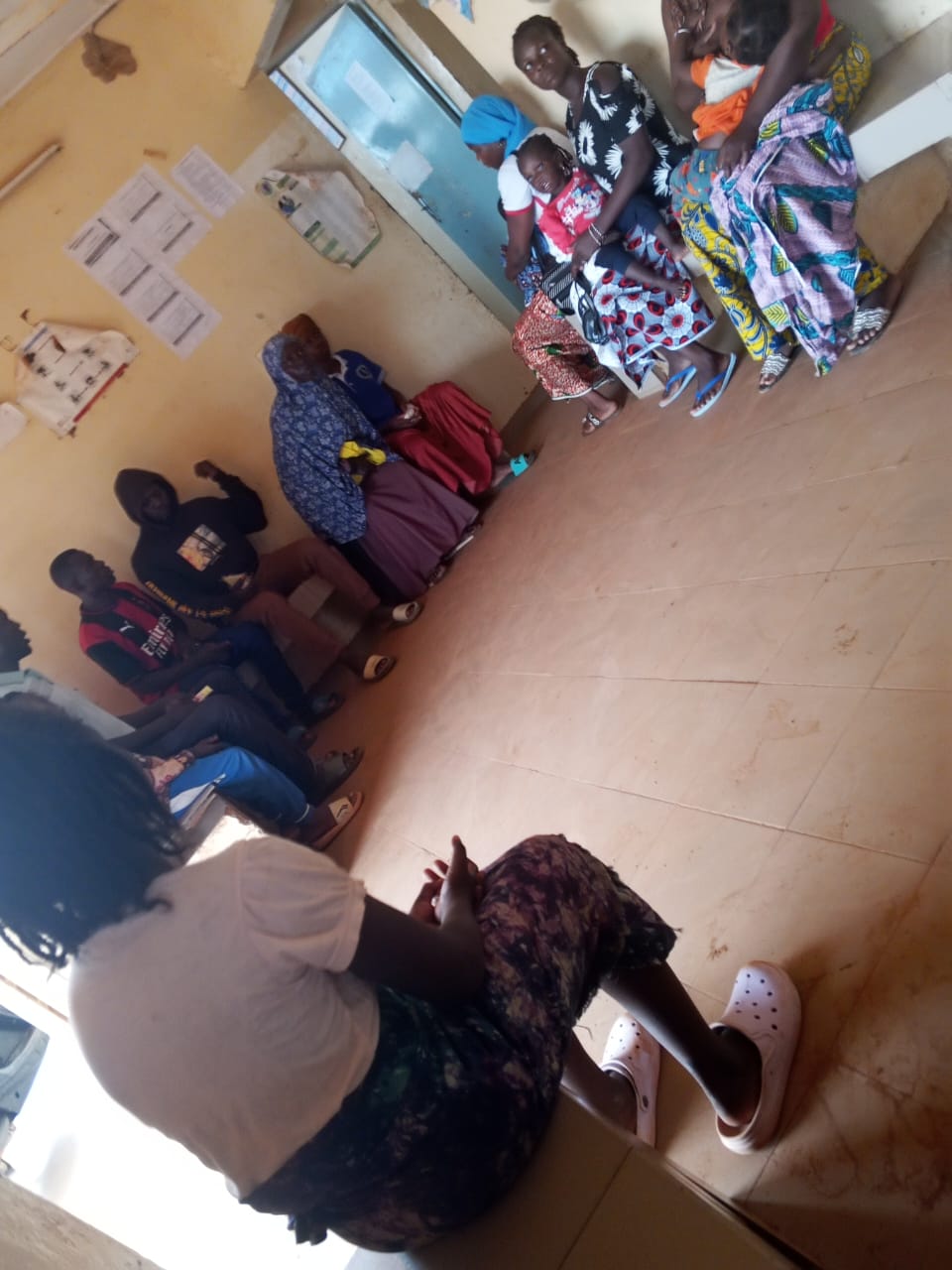
La gratuité changeait alors de statut. D'une question portée essentiellement dans les milieux sanitaires, scientifiques et associatifs, elle devenait un enjeu de compétition politique. Cette évolution était aussi facilitée par une caractéristique de la mesure : ses effets pouvaient être facilement compris par les populations. Pour une famille, emmener un enfant dans une formation sanitaire sans avoir à payer constitue un changement directement perceptible. La gratuité disposait donc d'une visibilité que n'ont pas nécessairement toutes les réformes publiques.
Cette évolution ne signifie toutefois pas que les ONG auraient simplement imposé leur revendication aux responsables politiques. Les données recueillies auprès des personnes interrogées montrent au contraire que le plaidoyer a rencontré des orientations déjà présentes dans le programme du Mouvement du peuple pour le progrès (MPP). Il s'est donc produit une convergence entre une cause construite depuis plusieurs années et une offre politique disposée à la reprendre. Ce type de période électorale peut justement modifier la place accordée à certaines questions et leur donner une importance nouvelle dans les priorités des responsables politiques (de Maillard, 2006).
La manière de présenter la gratuité évolue également. Aux arguments portant jusque-là principalement sur les barrières financières et la protection des populations vulnérables se sont ajoutées des références au développement du capital humain, au bien-être des populations et à la responsabilité sociale de l'État. La Déclaration de politique générale de février 2016, qui fait du développement du capital humain une priorité, montre ainsi que la gratuité pouvait désormais être rattachée à des orientations plus larges de l'action gouvernementale.
L'élection présidentielle de novembre 2015 ouvre ensuite une nouvelle séquence politique. Mais là encore, le résultat de l'étude invite à éviter une explication trop simple : l'élection n'a pas automatiquement produit la gratuité. Les entretiens montrent surtout qu'après 2014, les conditions de réception de cette mesure avaient changé. Des travaux scientifiques et des propositions qui avaient déjà été diffusés auparavant trouvaient désormais un environnement politique plus réceptif.
Ce n'était donc pas seulement le problème ou la solution qui changeaient ; c'était aussi le contexte dans lequel ils étaient discutés et susceptibles d'être retenus.
Un autre élément a compté dans ce passage vers la décision : l'État ne partait pas de zéro. Depuis 2006, la subvention des soins obstétricaux et néonataux d'urgence avait déjà familiarisé l'administration sanitaire avec le principe d'une prise en charge publique d'une partie des coûts liés à la grossesse et à l'accouchement. La gratuité représentait certes un changement d'échelle important, mais elle pouvait s'appuyer sur une expérience et des outils déjà connus. Cette continuité a facilité sa transformation en solution pouvant être envisagée à l'échelle nationale.
Le calendrier politique a également joué. Au début de l'année 2016, le nouveau pouvoir devait commencer à traduire certains de ses engagements en mesures concrètes, tandis que les élections municipales approchaient. Une mesure sociale immédiatement perceptible par les populations pouvait alors acquérir une importance particulière. Les travaux de de Maillard (2006) montrent précisément que les échéances politiques peuvent accélérer ou ralentir certaines décisions publiques. Cela ne signifie pas que la gratuité puisse être réduite à un calcul électoral : le problème avait été construit, la solution expérimentée et le plaidoyer engagé bien avant cette période.
Entre une promesse politique et une décision effectivement mise en œuvre, il restait cependant encore un choix à faire. L'étude montre qu'au sein même de l'administration sanitaire, certaines réserves persistaient concernant les conditions techniques de la réforme. Le temps de la décision politique et celui de la préparation administrative ne coïncidaient donc pas entièrement. Pourtant, l'arbitrage réalisé au sommet de l'exécutif a finalement transformé la gratuité en priorité gouvernementale.
C'est ici que le résultat de l'étude prend tout son sens. Un problème reconnu, une solution disponible et un contexte politique favorable peuvent créer les conditions d'une décision sans la rendre automatique (Kingdon, 1995). Parmi les nombreuses revendications et promesses présentes après l'insurrection et pendant la campagne électorale, toutes ne pouvaient devenir simultanément des priorités. Il fallait encore opérer un choix. La gratuité a finalement été retenue parmi ces différents engagements, illustrant ainsi le travail de sélection qui accompagne l'accès d'une question aux priorités gouvernementales (Garraud, 1990).
Conclusion
Cette étude montre que la gratuité des soins adoptée en 2016 ne résulte pas de la découverte soudaine d'un problème sanitaire. Les difficultés financières d'accès aux soins étaient anciennes et des solutions avaient déjà été expérimentées.
Ainsi, ce qui explique la décision de 2016 n'est ni la seule gravité des difficultés d'accès aux soins, ni les seules preuves scientifiques, ni la seule compétition électorale. C'est la succession de plusieurs transformations : une cause construite et rendue visible au fil des années, une solution déjà expérimentée, son entrée dans la compétition politique, sa rencontre avec des orientations favorables, l'existence d'expériences administratives antérieures et, enfin, un arbitrage qui la retient parmi plusieurs priorités possibles.
L'expérience burkinabè rappelle donc une leçon plus générale : un problème, même bien documenté, ne devient pas automatiquement une priorité gouvernementale. Entre la connaissance d'une difficulté et la décision d'agir se trouvent des acteurs, des stratégies, des occasions politiques et, finalement, un choix.
Cet article de vulgarisation est une synthèse de l'article original intitulé « Pourquoi la gratuité des soins en 2016 au Burkina Faso ? De la construction du problème à la sélection politique d'une solution », publié par Mohamadi ZEBA dans la Revue internationale de droit et science politique (R.I.D.S.P.), vol. 6, n° 8, août 2026.
ZEBA Mohamadi
Institut des Sciences des Sociétés (INSS/CNRST), Ouagadougou, Burkina Faso
zebafils@yahoo.fr
Références bibliographiques
HASSENTEUFEL PATRICK (2010), « Les processus de mise sur agenda : sélection et construction des problèmes publics », Informations sociales, n° 157, pp. 50-58.
KINGDON J. W. (1995), Agendas, Alternatives, and Public Policies, 2e éd., New York, Harper Collins College Publishers.
KÜBLER D. et DE MAILLARD J. (2009), Analyser les politiques publiques, Grenoble, Presses universitaires de Grenoble.
OLIVIER DE SARDAN J.-P. et RIDDE V. (2012), « L'exemption de paiement des soins au Burkina Faso, Mali et Niger : les contradictions des politiques publiques », Afrique contemporaine, n° 243, pp. 11-32.
RIDDE V. et YAMÉOGO P. (2018), « How Burkina Faso used evidence in deciding to launch its policy of free healthcare for children under five and women in 2016 », Palgrave Communications, vol. 4, art. 119, pp. 1-9.
ZEBA Mohamadi (2026), « Pourquoi la gratuité des soins en 2016 au Burkina Faso ? De la construction du problème à la sélection politique d'une solution », Revue internationale de droit et science politique (R.I.D.S.P.), vol. 6, n° 8, août 2026, pp. 379-404. L'article apparaît dans la rubrique Science politique à partir de la page 379.
Ce document de vulgarisation est tiré de l'article scientifique :
ZEBA Mohamadi (2026), « Pourquoi la gratuité des soins en 2016 au Burkina Faso ? De la construction du problème à la sélection politique d'une solution », Revue internationale de droit et science politique (R.I.D.S.P.), vol. 6, n° 8, août 2026, pp. 379-404.
Categories: Afrique
Maroc: Fatima Ezzahra El Mansouri nommée cheffe du gouvernement, une première pour une femme
Le roi Mohammed VI a nommé, mardi 29 septembre 2026, Fatima Ezzahra El Mansouri au poste de cheffe du gouvernement après la victoire de son parti aux élections législatives de la semaine dernière, selon un communiqué du cabinet royal. C'est une première historique et un symbole fort au Maroc : elle devient la première femme à accéder à ce poste.
Categories: Afrique
Strategic Blindness at UNGA 81: “Super Intelligence” and “Killer Robots” Take Center Stage as Women’s Rights Take a Back Seat
Credit: United Nations
By Shihana Mohamed
NEW YORK, Sep 29 2026 (IPS)
“Artificial intelligence (AI) must be shaped by humanity, with humanity, and for all humanity… Life-and-death decisions must never be surrendered to machines. Killer robots must have no place in our future.”
With those words, United Nations Secretary-General António Guterres opened the high-level debate of the 81st session of the General Assembly (UNGA 81). He also warned: “Women and girls continue to face discrimination, violence, exclusion and abuse… Their rights are being rolled back. Their voices silenced. Their bodies turned into battlegrounds.”
Both technological transformation and the erosion of women’s rights were placed before the world, yet the political response to each was markedly different.
Opening speeches focused heavily on technology. French President Emmanuel Macron warned that a few powers could decide the planet’s future through AI and urged states to build independent, open-source models; UK Prime Minister Andy Burnham called for global cooperation on transparency and ethics; China’s Vice President Han Zheng stressed a people-centered approach to narrowing the digital divide; and Russia’s Foreign Minister Sergey Lavrov called for the UN to lead AI rule-setting through equal participation.
U.S. President Donald Trump focused on U.S. technological leadership. He declared that the United States was outcompeting the world and called for a change in terminology: “From this point forward, all U.S. documents—and hopefully the world—will use the more accurate term super rather than artificial. So, it’s super intelligence.”
Shihana Mohamed
Disparity is also reflected in the numbers. By Saturday, September 26, 2026, 86 of the 174 speakers had raised technology and AI, compared with 46 who raised human rights and gender.The question is unavoidable: why has the international system shown such urgency in governing emerging technologies while allowing the erosion of women’s rights to remain a secondary concern?
Twin Transformations
The 81st session convened under the theme, “Restoring trust, managing transformation: a United Nations that delivers for all.” That theme highlights two defining transformations: the rapid expansion of generative AI and the growing political backlash against the rights of women and girls.
The United Nations treats both as critical to achieving the 2030 Sustainable Development Goals, yet world leaders are not giving them equal political weight. AI is being elevated as an urgent global governance challenge, while gender equality is increasingly treated as a goal that can wait.
That is a dangerous disconnect.
AI is already reshaping economies, labour markets and public life. It will influence who gets opportunities, whose work is automated, and whose voices are represented in the systems that increasingly influence daily life.
Declining Gender Momentum
AI has ascended to the top tier of global political concerns. Leaders are focused on governance, innovation, digital sovereignty, security, and technological competition.
Meanwhile, the momentum on gender equality is moving in the opposite direction. UN Women and UN DESA report that one in three institutional mechanisms for gender equality has lost institutional power over the past two years. Around one in four have seen their operating budgets cut, while nearly one in ten have lost control of their budgets altogether.
Globally, progress on women’s political and executive participation is reversing. At the current rate of progress, the report projects that global gender equality could be achieved only by 2197, far beyond the UN’s 2030 target.
There is a basic leadership question that Member States have yet to answer: Why has no woman ever been selected as Secretary-General of the United Nations?
The problem is not a shortage of promises but the widening gap between rhetoric and political action.
The Funding Disparity
The resource gap makes that contrast tangible.
Global venture-capital investment in AI firms reached $258.7 billion in 2025, accounting for 61% of total global VC investment, according to the OECD. Philanthropic investment is also growing, including the Gates Foundation’s September 2026 commitment to spend at least $1 billion over two years on equitable access to AI and AI-enabled solutions.
Funding for women’s rights is contracting.
Funding for gender equality fell 13% between 2023 and 2024, while funding for women’s rights organizations declined by 28% over the same period.
This is not merely a funding problem; it reflects what the international community considers urgent.
The world is mobilizing enormous capital to build the technologies that will define the future while reducing resources for the organizations working to ensure that women have an equal place in it.
Women Left Behind in the AI Economy
The gender gap is already visible inside the AI economy.
UN Women’s 2026 Gender Snapshot reports that women account for around 22% of AI professionals globally and fewer than 14% of senior leadership positions, based on an analysis of nearly 1.6 million AI professionals.
Women are around 20% less likely than men to use generative AI tools. The result is a persistent gap in both the development and adoption of AI—and a fundamental question about whose perspectives are shaping the future of work.
The International Labour Organization finds that female-dominated occupations are almost twice as likely to be exposed to generative AI as male-dominated occupations—29% compared with 16%. Women’s concentration in clerical, administrative, and business-support roles, where many tasks are routine and codifiable, contributes significantly to this disparity.
AI is intensifying digital violence against women in public life. UN Women reports increasing use of AI-generated deepfakes, manipulated images and coordinated online harassment against women in public-facing roles. Such abuse can intimidate women and undermine their participation in public life.
UN Women estimates that 90–95% of online deepfakes are non-consensual pornographic images, with around 90% depicting women.
This is where the two crises converge. The same technology being celebrated as transformative is also being used to threaten women’s economic security, public participation, and personal safety.
Immediate Mandates for AI and Gender Equality
More than three decades after the 1995 Beijing Declaration and Platform for Action set a global framework for gender equality, the world remains far from its commitments.
The General Assembly must move beyond another cycle of declarations and voluntary targets and act where technology, funding and gender rights now intersect.
- • Enforce Financial Reciprocity via a Global Tech Solidarity Fund: The General Assembly should establish a mechanism requiring a fixed share of global digital-transformation investment to support grassroots women’s organizations, and strengthen their technical capacity, infrastructure and advocacy.
• Establish an International Enforcement Mechanism with the Urgency Applied to AI: The UN should address the erosion of women’s rights with the same urgency applied to emerging technological threats. The General Assembly should establish a global monitoring mechanism empowered to impose diplomatic and financial consequences on states that roll back women’s legal protections.
• Criminalize Technology-Facilitated Abuse and Mandate Safety-by-Design: The General Assembly should advance a binding international treaty classifying AI-generated deepfakes weaponized against women in public life as violations of international human rights law. Technology companies should be required to address algorithmic bias and security failures that endanger women’s participation in public life.
If world leaders truly intend to “manage transformation” and “restore trust,” they cannot continue treating women’s empowerment as a secondary issue.
The willingness to govern the digital frontier must extend to protecting the women who live and work within it.
Otherwise, the “super intelligence” that leaders celebrate will not simply become an engine of economic growth. It could also become a powerful tool for reinforcing the structural exclusion of half the human race.
Shihana Mohamed is the President of Asia Global Forum (www.AsiaGlobalForum.org) and a US Public Voices Fellow on advancing the rights of women and girls. She is the founder of the UN Asia Network for Diversity & Inclusion (www.UN-ANDI.org) and a dedicated human rights activist and a strong advocate for gender equality and the advancement of women.
IPS UN Bureau
Categories: Africa
Son of Zambian bishop detained in post-election raid fears for his father's safety
Trevor Mwamba was detained last month with other opposition figures and charged with treason, his son says.
Categories: Africa
Modernisation des services consulaires : Le Burkina Faso lance YORI ID aux États-Unis
L'Ambassade du Burkina Faso aux États-Unis d'Amérique a procédé au lancement officiel de YORI ID, une plateforme numérique destinée à moderniser les services consulaires, améliorer la gestion des ressortissants burkinabè et dématérialiser plusieurs démarches administratives. La cérémonie, tenue en ligne, a été présidée par le ministre des affaires étrangères, Karamoko Jean Marie Traoré, en présence de l'ambassadeur du Burkina Faso aux États-Unis d'Amérique, Kassoum Coulibaly. La cérémonie a également vu la participation de la consule générale du Burkina Faso à Washington, DC, Estelle Pélagie Segda/Gango.
Faire de la distance géographique un obstacle moins contraignant dans la relation entre le citoyen burkinabè de l'extérieur et son administration. C'est l'une des ambitions affichées par YORI ID, la nouvelle plateforme numérique lancée officiellement par l'Ambassade du Burkina Faso aux États-Unis d'Amérique. Conçue comme un guichet unique consulaire digital, la solution entend apporter une réponse à plusieurs difficultés auxquelles sont confrontés les ressortissants à l'étranger. Procédures longues, déplacements physiques, absence de données centralisées et communication parfois difficile avec les représentations diplomatiques sont autant de réalités qui justifient la conception de cette solution.
La plateforme est née d'une initiative engagée dès 2019. À l'origine, explique son concepteur, Moussa Koné, il s'agissait de moderniser la délivrance des cartes consulaires. À cette époque, celles-ci étaient encore produites sur support cartonné. L'expérience a progressivement conduit à une réflexion plus large sur la digitalisation des services consulaires, jusqu'à l'aboutissement de YORI ID.
Un espace numérique pour les ressortissants
YORI ID offre un espace accessible au public (front office), permettant aux ressortissants de s'adresser à distance à l'administration consulaire. L'usager renseigne ses informations et transmet les pièces nécessaires à son identification. Son inscription n'est toutefois effective qu'après validation par les agents consulaires, chargés de vérifier les documents fournis et notamment la preuve de la nationalité burkinabè.
« YORI ID va bientôt, moderniser également le Consulat honoraire du Burkina Faso New Jersey et à Houston », Estelle Pélagie Segda/Gango, consule générale du Burkina Faso à Washington, DCUne fois enregistré, le ressortissant peut accéder à différents services. Il peut notamment demander ou renouveler sa carte consulaire, effectuer une déclaration en cas de perte, solliciter des actes administratifs et suivre l'évolution de ses démarches. La plateforme intègre également la possibilité de demander un passeport, y compris pour les enfants.
L'objectif est ainsi de limiter les déplacements aux situations qui les rendent réellement nécessaires. Pour les ressortissants vivant loin des représentations diplomatiques, la plateforme constitue un point d'accès numérique aux services consulaires.
Des démarches progressivement dématérialisées
L'une des particularités de YORI ID réside dans sa capacité à intégrer différents types de documents et de procédures. Les services consulaires peuvent créer leurs propres modèles de documents, définir les modalités de délivrance et préciser si les prestations sont payantes ou gratuites avant leur mise en ligne. La plateforme distingue, à cet effet, les documents pouvant être délivrés automatiquement après paiement des frais requis et ceux qui nécessitent un délai de traitement en fonction de leur nature et du processus administratif.
La dématérialisation concerne également les paiements. L'usager peut régler certaines prestations par carte bancaire ou de débit, recevoir un lien de paiement sur son téléphone ou effectuer le paiement sur place à l'aide d'un terminal. Le système permet également de prendre en compte les paiements par money order. Sur le plan comptable, les différentes opérations liées aux actes payants sont centralisées afin de permettre leur suivi par les agents compétents.
« Lorsqu'un acte est délivré gratuitement, l'agent peut également renseigner le motif justifiant cette exonération », Moussa Koné, concepteur de YORI IDUn canal direct avec la diaspora
Au-delà des démarches administratives, YORI ID entend renforcer la communication entre les représentations diplomatiques et leurs ressortissants. Les agents disposent d'outils leur permettant d'échanger directement avec les usagers, notamment lorsqu'un dossier nécessite une information ou une pièce complémentaire.
La plateforme permet également à l'ambassade de diffuser des informations à destination de la diaspora. Actualités, annonces, liens vers différents services ou opportunités peuvent ainsi être publiés sur le portail. Des fonctionnalités supplémentaires peuvent être ajoutées en fonction des besoins des représentations diplomatiques.
Plus de 10 000 ressortissants déjà enregistrés
YORI ID ne part pas d'une base vierge. Selon son concepteur, les données de l'ancien système ont été transférées, avec plus de 8 000 personnes déjà intégrées. À ce jour, la plateforme compte environ 10 000 personnes enregistrées. Cette base constitue également un outil potentiel d'aide à la connaissance de la diaspora. À terme, le ministère des Affaires étrangères pourra disposer d'une visibilité sur les ressortissants enregistrés au niveau des différentes représentations, notamment pour répondre à des besoins statistiques.
La sécurité des données figure parmi les principes annoncés par les concepteurs. Les informations enregistrées sont présentées comme sécurisées et demeurent la propriété de l'État du Burkina Faso. Le système prévoit par ailleurs une application téléchargeable sur App Store et Play Store, permettant de vérifier l'authenticité des documents délivrés à travers YORI ID.
Une phase pilote avant un déploiement plus large
Le lancement aux États-Unis constitue une phase pilote d'une durée d'un an. Cette période doit permettre aux responsables de l'ambassade et du consulat général de tester le dispositif, d'identifier les éventuelles difficultés et de contribuer à son amélioration. L'ambition affichée dépasse toutefois le seul cadre de la représentation burkinabè aux États-Unis. Le projet vise à terme, une couverture de l'ensemble du territoire américain, soit les 50 États, le District de Columbia et les cinq territoires des États-Unis d'Amérique.
Le dispositif est également conçu pour pouvoir être déployé dans d'autres représentations diplomatiques. Selon Moussa Koné, la solution pourrait être installée dans n'importe quelle ambassade ou consulat, ouvrant ainsi la voie à une extension progressive de l'outil.
À travers YORI ID, l'enjeu est donc plus large qu'une simple mise en ligne de formulaires. Il s'agit de repenser la relation entre l'administration consulaire et les Burkinabè établis à l'étranger, en rapprochant les services de l'usager, en réduisant certaines contraintes liées à la distance et en dotant les représentations d'outils pour mieux connaître, accompagner et communiquer avec leur diaspora.
Le lancement de cette plateforme aux États-Unis marque ainsi une nouvelle étape dans la digitalisation des services consulaires burkinabè, avec une expérimentation appelée à fournir les enseignements nécessaires à son évolution et à son éventuel déploiement à plus grande échelle.
Hamed Nanéma
Lefaso.net
Categories: Afrique
Art contemporain d’Afrique : à Paris, Hervé Yamguen explore nos « géographies intimes »
L’artiste camerounais présente ses dernières œuvres dans la galerie Afikaris, située dans le 3ᵉ arrondissement de la capitale. Au menu de l’exposition, des peintures, dessins, sculptures et masques, reflets de ses vibrations intérieures. Jusqu’au 31 octobre.
Categories: Afrique
Quelques œuvres d’Hervé Yamguen
L’artiste camerounais présente ses dernières réalisations à la galerie Afikaris, à Paris. Au menu de l’exposition « Nos géographies intimes » : peintures, dessins, sculptures et masques. Jusqu’au 31 octobre.
Categories: Afrique
L’Ethiopie accuse l’Erythrée, le Soudan et l’Egypte de soutenir les rebelles
Le chef d’état-major général de l’armée éthiopienne a directement accusé, jeudi 24 septembre, les trois pays et « d’autres puissances extérieures » de soutenir la nouvelle alliance de groupes d’opposition qui mène depuis une semaine une offensive d’ampleur dans le nord du pays.
Categories: Afrique
Au Maroc, le roi nomme pour la première fois une femme, Fatima Ezzahra El-Mansouri, à la tête du gouvernement
Près d’une semaine après la victoire du PAM, son parti, aux législatives, la maire de Marrakech a été désignée, mardi 29 septembre, première ministre du Maroc.
Categories: Afrique
Irlande du Nord: vives tensions après le blocage d'une marche orangiste
Depuis dimanche 27 septembre, des centaines de personnes bloquent le passage d'un défilé protestant dans le quartier majoritairement catholique de Drumcree, à Portadown. Le face-à-face reste pour l'instant pacifique, mais il constitue l'un des pires regains de tension dans la province depuis l'accord de paix de 1998.
Categories: Union européenne
DRAFT REPORT on human rights and democracy in the world and the European Union’s policy on the matter – annual report 2026 - PE796.193v01-00
DRAFT REPORT on human rights and democracy in the world and the European Union’s policy on the matter – annual report 2026
Committee on Foreign Affairs
Isabel Wiseler-Lima
Source : © European Union, 2026 - EP
Committee on Foreign Affairs
Isabel Wiseler-Lima
Source : © European Union, 2026 - EP
Categories: Europäische Union
DRAFT REPORT on human rights and democracy in the world and the European Union’s policy on the matter – annual report 2026 - PE796.193v01-00
DRAFT REPORT on human rights and democracy in the world and the European Union’s policy on the matter – annual report 2026
Committee on Foreign Affairs
Isabel Wiseler-Lima
Source : © European Union, 2026 - EP
Committee on Foreign Affairs
Isabel Wiseler-Lima
Source : © European Union, 2026 - EP
Categories: European Union
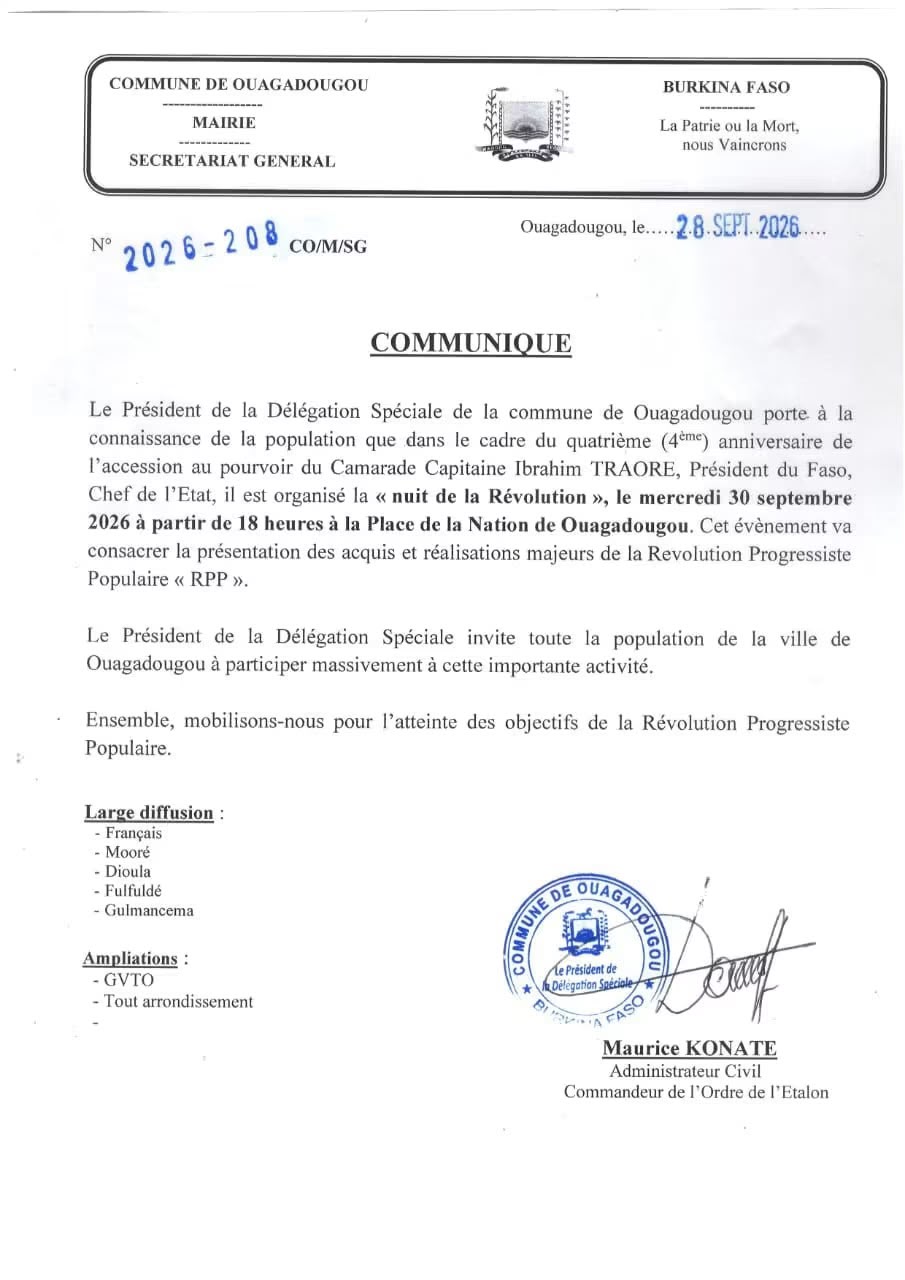
« Nuit de la Révolution » : Le président de la Délégation spéciale de la commune de Ouagadougou invite les populations à participer massivement
Dans un communiqué publié ce lundi 28 septembre 2026 sur sa page Facebook, la mairie de Ouagadougou annonce l'organisation de la « Nuit de la Révolution », prévue pour le mercredi 30 septembre 2026 à partir de 18 heures à la Place de la Nation.
Selon le communiqué, cette activité s'inscrit dans le cadre du quatrième anniversaire de l'accession au pouvoir du capitaine Ibrahim Traoré, Président du Faso et Chef de l'État.
La cérémonie sera ainsi consacrée à la présentation des principaux acquis et réalisations de la « Révolution progressiste populaire (RPP) », précise la mairie.
Le président de la Délégation spéciale de la commune de Ouagadougou, Maurice Konaté, invite par ailleurs les populations de la capitale à participer massivement à cette activité pour l'atteinte des objectifs de la Révolution progressiste populaire.
Lefaso.net
Source : Page Facebook de la mairie de Ouagadougou
Categories: Afrique
Selon le Sénat, le rétablissement d’une composante nucléaire terrestre pourrait être une «option à ne pas négliger»
Lors d’un discours prononcé sur la base navale de l’Île-Longue, le 2 mars, le président Macron fit savoir que, compte tenu du contexte international et de l’évolution des menaces, il avait «ordonné d’augmenter le nombre de têtes nucléaires» de l’arsenal français, l’idée étant de passer du concept de «stricte suffisance» à celui de «stricte cohérence»....
Cet article Selon le Sénat, le rétablissement d’une composante nucléaire terrestre pourrait être une «option à ne pas négliger» est apparu en premier sur Zone Militaire.
Categories: Défense
Le Prix du Grand-Maître des ordres pour les jeunes Béninois
Le Prix du Grand-Maître des ordres ouvre un nouveau cadre de distinction aux jeunes Béninois qui se démarquent par leurs performances académiques, leurs réalisations professionnelles ou leur engagement en faveur de la bonne gouvernance.
Les jeunes Béninois de moins de 30 ans pourront désormais voir leurs parcours distingués dans le cadre du Prix du Grand-Maître des ordres.
Institué par la Loi n°2024-28 du 26 juillet 2024 portant création des Ordres nationaux du Bénin, les modalités d'attribution du prix ont été précisées dans le décret n°2026-407 du 1er juillet 2026.
Le Prix du Grand-Maître des ordres vise à reconnaître des parcours jugés remarquables dans certains domaines.
L'excellence académique parmi les critères
Pour être éligibles, les candidats doivent avoir fait preuve « d'excellence au cours de leur formation ou de compétence et de bonne gouvernance en milieu professionnel », selon l'article premier du décret n°2026-407 du 1er juillet 2026.
La première catégorie (excellence académique) concerne notamment « les jeunes ayant obtenu des résultats exceptionnels ou ayant réalisé des projets innovants dans le cadre de leur formation scolaire, universitaire ou professionnels ». Le jury examinera les moyennes ou diplômes obtenus avec mention, les succès à des concours sous-régionaux, régionaux ou internationaux, la promotion d'un projet innovant ainsi que les publications scientifiques ou techniques.
La deuxième catégorie porte sur la compétence professionnelle et la bonne gouvernance en milieu professionnel. Elle concerne les jeunes ayant démontré leur maîtrise technique, obtenu des résultats dans leur domaine et contribué de manière significative à leur organisation ou à leur communauté. Le jury prendra également en compte les pratiques éthiques et responsables, la transparence dans la gestion et la participation inclusive à la prise de décision.
Une distinction assortie de dotation
Le prix comprend une médaille et une attestation, ainsi qu'une dotation financière dont le montant doit être défini par décret du Président de la République.
Le texte prévoit également une possibilité d'attribution « à titre exceptionnel » par le Chef de l'Etat, indépendamment des dispositions ordinaires relatives au jury, aux critères et à la procédure de candidature.
La remise du prix est prévue au cours du dernier trimestre de chaque année, lors d'une cérémonie officielle présidée par le vice-président de la République, Grand chancelier des ordres nationaux du Bénin.
Ce que les candidats doivent préparer
Pour les jeunes intéressés, le décret prévoit une procédure annuelle. Un appel à candidatures doit être publié au cours du deuxième trimestre de chaque année par le vice-président de la République, Grand chancelier des ordres nationaux du Bénin.
Le dossier doit notamment comprendre une lettre de motivation, un curriculum vitae comportant les coordonnées d'au moins deux personnes de référence, les justificatifs des performances académiques ou professionnelles et deux lettres de recommandation. L'avis d'appel peut demander des pièces supplémentaires.
La période de dépôt des dossiers ne peut excéder 60 jours.
L'examen des candidatures est confié à un jury de sept membres. Celui-ci comprend notamment des représentants des ministères chargés de l'éducation, de la Jeunesse, de la Fonction publique et des Entreprises, deux personnalités de grande réputation professionnelle et un représentant de la Chambre de Commerce et d'Industrie du Bénin.
La remise des distinctions est prévue au cours du dernier trimestre de chaque année, lors d'une cérémonie officielle présidée par le vice-président de la République, Grand chancelier des ordres nationaux du Bénin.
M. M.
Le Decret portant prix du Grand-Maître des ordres
Categories: Afrique
Ciotti, Lisnard, Kasbarian… Le modèle Milei infuse dans la classe politique française
DÉCRYPTAGE - Alors que le président argentin est attendu en France dès mercredi, sa politique libérale, décriée par la gauche, inspire une partie de la droite et du bloc central.
Categories: France
Taiwan Should Be Kept Off the Negotiating Table
The fact that Trump didn’t give anything new away on Taiwan shouldn’t obscure how much ground he has already conceded to Xi.
Categories: Diplomacy & Crisis News
Éliminatoires CAN 2027 : les grandes histoires de la 2e journée avec AfroPari
Les éliminatoires de la CAN 2027 entrent dans leur deuxième journée de phase de groupes. Répartis en 12 groupes de quatre, les participants s'affrontent en matches aller-retour, et les rencontres de cette 2e journée se jouent jusqu'au 6 octobre.
La première journée s'est disputée du 24 au 26 septembre, pendant la même fenêtre internationale FIFA. Les groupes des pays hôtes obéissent à une règle particulière : le Kenya (groupe D), l'Ouganda (groupe H) et la Tanzanie (groupe L) sont déjà qualifiés pour la CAN 2027 en tant que coorganisateurs. Les trois autres sélections de ces groupes se disputent donc un seul billet. Chaque point perdu y pèse d'autant plus lourd.
Éthiopie - Sénégal, 29 septembre
À Bahir Dar, deux équipes du groupe J qui ont mal démarré se retrouvent face à face. L'Éthiopie s'est inclinée 0-1 face au Soudan. Le Sénégal a été tenu en échec 1-1 par le Mozambique lors du premier match officiel de Patrick Vieira sur le banc. Sadio Mané est absent de la liste : en attaque, les regards se tournent vers le trio de Premier League Nicolas Jackson, Ismaïla Sarr et Iliman Ndiaye.
Le dossier sénégalais se joue aussi en dehors du terrain. Le 8 octobre, le Tribunal arbitral du sport (TAS) examinera l'appel de la fédération concernant le titre de la CAN 2025, attribué au Maroc par la CAF.
Cotes AfroPari : Éthiopie – 7.65, nul – 4.8, Sénégal – 1.35.
Guinée-Bissau - Nigeria, 29 septembre
Les deux sélections ont remporté leur premier match. La Guinée-Bissau s'est imposée 2-0 en Tanzanie, le Nigeria a battu Madagascar 2-1. Les voici face à face dans le groupe L, où un seul billet est en jeu puisque la Tanzanie est déjà qualifiée comme pays hôte.
Le Nigeria jouera sans Victor Osimhen. Eric Chelle compte sur Ademola Lookman et Samuel Chukwueze.
Cotes AfroPari : Guinée-Bissau – 6.86, nul – 3.74, Nigeria – 1.5.
Ghana - Gambie, 29 septembre
Le Ghana a débuté par une défaite 0-2 face à la Côte d'Ivoire et reste une nouvelle fois muet. L'effectif est aussi touché : Mohammed Kudus, Antoine Semenyo, Jordan Ayew et Thomas Partey manquent à l'appel. La Gambie a connu le départ inverse, avec une victoire 2-1 contre la Somalie.
Ce sont ces mêmes Scorpions qui avaient atteint les quarts de finale de la CAN 2021 pour leur toute première participation.
Cotes AfroPari : Ghana – 1.38, nul – 4.3, Gambie – 8.2.
Zambie - Togo, 29 septembre
La Zambie a été championne d'Afrique en 2012, le Togo a disputé la Coupe du monde 2006. Les deux sélections ont pris des départs opposés. Les Chipolopolo se sont inclinés 1-3 face à l'Algérie. Les Éperviers ont arraché une victoire 1-0 contre le Burundi.
Le Togo sera privé de Kennedy Boateng, blessé.
Cotes AfroPari : Zambie – 1.95, nul – 3.15, Togo – 4.00.
Cap-Vert - Rwanda, 29 septembre
Pour sa première Coupe du monde, en 2026, le Cap-Vert a atteint les seizièmes de finale, où il a affronté l'Argentine. Après le tournoi, Humberto Bettencourt a pris la succession de Bubista. Mais les Requins bleus ont mal démarré ces éliminatoires, avec une défaite 1-3 face au Mali.
Le Rwanda, lui, a lancé ses éliminatoires par une victoire 3-1 contre le Liberia. Les Amavubi arrivent à Praia avec trois points.
Cotes AfroPari : Cap-Vert – 1.41, nul – 4.05, Rwanda – 8.1.
Les autres matches de la journée
● Madagascar – Tanzanie (L, 29.09)
● Bénin – Mauritanie (F, 29.09)
● Congo – Cameroun (G, 29.09)
● Soudan du Sud – Égypte (B, 29.09)
● Lesotho – Maroc (A, 29.09)
● Somalie – Côte d'Ivoire (C, 29.09)
● Guinée – Kenya (D, 01.10)
● Angola – Malawi (B, 06.10)
Pendant que les sélections se disputent les billets pour la CAN 2027, la saison des clubs ne fait que commencer. Et pour les amateurs des grands championnats, le Grand Football Quest est lancé : de septembre 2026 à mai 2027, trois étapes où le nombre de paris validés sur les plus grandes compétitions détermine le niveau de ta récompense. Plus tu places de paris éligibles, plus le prix est important, jusqu'à 50 $.
Combine un match des éliminatoires de la CAN et une affiche de la Ligue des champions ou des grands championnats européens dans un même combiné, et avance dans les étapes du Grand Football Quest avec AfroPari.
Categories: Afrique
Présidentielle 2027 : 67 ans et 80 km/h, les deux nombres maudits dont Édouard Philippe veut se débarrasser
DÉCRYPTAGE - Le candidat d’Horizons à la présidentielle, qui a proposé mardi de reporter à 65 ans l’âge légal de départ à la retraite, veut cesser d’apparaître comme l’«homme des 67 ans», tout comme il a ajusté son discours sur la limitation de vitesse à 80 km/h.
Categories: Diplomacy & Defense Think Tank News, France
Pages


© 2012-2018 Europa Varietas Foundation © 2015-2018 Europa Varietas Association
www.europavarietas.org | info(@)europavarietas(dot)org | Switzerland


We are looking for sponsors for the English translation of these books, please contact turkeandras(at)gmail(dot)com