
You are here
Diplomacy & Defense Think Tank News
Science-policy interfaces and sustainable development: institutionally bridging the knowledge–action gap
This chapter describes science-policy interfaces (SPIs) as an opportunity to support sustainable development by bridging the knowledge-action gap and fostering evidence-based policies. The biggest challenges of sustainable development presented and discussed in previous chapters, including climate change, biodiversity loss, environmental injustice, and pandemics, are growing increasingly complex and uncertain. It has long been argued that for public interventions, such as policies, to more effectively address such problems and enhance sustainable development, structured evidence-based advice is needed.
Based on examples and theoretical knowledge from the literature, the chapter demonstrates how SPIs have the potential to fill knowledge gaps and foster concerted action on complex sustainability problems, specifically related to the environmental dimensions of sustainable development. Examples of prominent SPIs at the global scale are the Intergovernmental Panel on Climate Change (IPCC) and the Intergovernmental Science-Policy Platform on Biodiversity and Ecosystem Services (IPBES), which we explore in depth later in the chapter.
The chapter also presents the scholarly discourse on the effectiveness of SPIs in brief, emphasising the importance of being aware of the benefits and limitations of SPIs and different models of formalised knowledge co-production. While many scholars advocate for a co-production model over a linear model, the literature agrees that there is no ‘one-size-fits-all’ solution for facilitating interactions and coordination between knowledge holders, policymakers, and other stakeholders to effectively enhance sustainable development and synergies between interventions. When talking about sustainable development, social-political contexts need to be considered because sustainability issues are inherently interlinked and political, as reiterated in previous chapters. This chapter emphasises that effective science-policy engagement requires a two-way, iterative knowledge exchange. This approach is essential for operationalising a co-production model that incorporates diverse perspectives and knowledge systems—an indispensable factor in addressing the complex, interlinked challenges of sustainable development. Building on the previous chapter’s exploration of the growing significance of science-policy interactions in sustainable development, we want to offer a behind-the-scenes perspective on the dynamics of major intergovernmental organisations shaping the science-policy interface.
Science-policy interfaces and sustainable development: institutionally bridging the knowledge–action gap
This chapter describes science-policy interfaces (SPIs) as an opportunity to support sustainable development by bridging the knowledge-action gap and fostering evidence-based policies. The biggest challenges of sustainable development presented and discussed in previous chapters, including climate change, biodiversity loss, environmental injustice, and pandemics, are growing increasingly complex and uncertain. It has long been argued that for public interventions, such as policies, to more effectively address such problems and enhance sustainable development, structured evidence-based advice is needed.
Based on examples and theoretical knowledge from the literature, the chapter demonstrates how SPIs have the potential to fill knowledge gaps and foster concerted action on complex sustainability problems, specifically related to the environmental dimensions of sustainable development. Examples of prominent SPIs at the global scale are the Intergovernmental Panel on Climate Change (IPCC) and the Intergovernmental Science-Policy Platform on Biodiversity and Ecosystem Services (IPBES), which we explore in depth later in the chapter.
The chapter also presents the scholarly discourse on the effectiveness of SPIs in brief, emphasising the importance of being aware of the benefits and limitations of SPIs and different models of formalised knowledge co-production. While many scholars advocate for a co-production model over a linear model, the literature agrees that there is no ‘one-size-fits-all’ solution for facilitating interactions and coordination between knowledge holders, policymakers, and other stakeholders to effectively enhance sustainable development and synergies between interventions. When talking about sustainable development, social-political contexts need to be considered because sustainability issues are inherently interlinked and political, as reiterated in previous chapters. This chapter emphasises that effective science-policy engagement requires a two-way, iterative knowledge exchange. This approach is essential for operationalising a co-production model that incorporates diverse perspectives and knowledge systems—an indispensable factor in addressing the complex, interlinked challenges of sustainable development. Building on the previous chapter’s exploration of the growing significance of science-policy interactions in sustainable development, we want to offer a behind-the-scenes perspective on the dynamics of major intergovernmental organisations shaping the science-policy interface.
Science-policy interfaces and sustainable development: institutionally bridging the knowledge–action gap
This chapter describes science-policy interfaces (SPIs) as an opportunity to support sustainable development by bridging the knowledge-action gap and fostering evidence-based policies. The biggest challenges of sustainable development presented and discussed in previous chapters, including climate change, biodiversity loss, environmental injustice, and pandemics, are growing increasingly complex and uncertain. It has long been argued that for public interventions, such as policies, to more effectively address such problems and enhance sustainable development, structured evidence-based advice is needed.
Based on examples and theoretical knowledge from the literature, the chapter demonstrates how SPIs have the potential to fill knowledge gaps and foster concerted action on complex sustainability problems, specifically related to the environmental dimensions of sustainable development. Examples of prominent SPIs at the global scale are the Intergovernmental Panel on Climate Change (IPCC) and the Intergovernmental Science-Policy Platform on Biodiversity and Ecosystem Services (IPBES), which we explore in depth later in the chapter.
The chapter also presents the scholarly discourse on the effectiveness of SPIs in brief, emphasising the importance of being aware of the benefits and limitations of SPIs and different models of formalised knowledge co-production. While many scholars advocate for a co-production model over a linear model, the literature agrees that there is no ‘one-size-fits-all’ solution for facilitating interactions and coordination between knowledge holders, policymakers, and other stakeholders to effectively enhance sustainable development and synergies between interventions. When talking about sustainable development, social-political contexts need to be considered because sustainability issues are inherently interlinked and political, as reiterated in previous chapters. This chapter emphasises that effective science-policy engagement requires a two-way, iterative knowledge exchange. This approach is essential for operationalising a co-production model that incorporates diverse perspectives and knowledge systems—an indispensable factor in addressing the complex, interlinked challenges of sustainable development. Building on the previous chapter’s exploration of the growing significance of science-policy interactions in sustainable development, we want to offer a behind-the-scenes perspective on the dynamics of major intergovernmental organisations shaping the science-policy interface.
Wenn Angst die Demokratie zerstört
Populisten unterscheiden sich von Demokraten vor allem in der Art, wie sie Angst instrumentalisieren. Sie glauben: Wer Angst macht, hat Macht. Und leider stimmt das. , Wer verstehen will, warum demokratische Gesellschaften heute so fragil geworden sind, muss nicht auf Migration, Globalisierung oder technologische Umbrüche schauen. Er muss auf die politische Instrumentalisierung von Angst blicken. Und die hat einen ökonomischen Kern. Neu ist, wie gezielt Angst ...
Deal or no Deal - Trump und die Grenzen der Macht
Moderation: Michaela Kolster
Categories: Afrique, Diplomacy & Defense Think Tank News
Overwhelmed: Germany’s Israel Policy after October 7th
Few countries have been as profoundly affected by the attacks of October 7th and the
subsequent Gaza war as Germany. This is not merely a political controversy. It reflects a
deeper structural problem.
Categories: Defence`s Feeds, Diplomacy & Defense Think Tank News


Israel-Palestine Monthly Brief
Developments and Implications for Political Arrangements
Key Takeaways
May 2026 was marked by a widening gap between an increasingly detailed international transition framework for Gaza and a deteriorating situation on the ground. At the center of this disconnect lies the deadlock over disarmament and decommissioning, which is blocking progress across the broader transition agenda, including withdrawal of the Israeli Defense Forces (IDF), reconstruction, and the deployment of the National Committee for the Administration of Gaza (NCAG). On May 21, High Representative Nickolay Mladenov presented a 15-point Roadmap for Phase Two centered on reciprocity and an independent verification mechanism designed to overcome the zero-trust environment between the parties.
The Roadmap is premised on the view that reconstruction, governance transition, and Israeli withdrawal cannot be sustainably implemented while multiple armed structures continue to operate alongside civilian institutions, and therefore places gradual, Palestinian-led decommissioning under NCAG authority at the center of the transition process. In practice, however, this sequencing links progress across multiple tracks to movement on the disarmament file. Hamas has rejected two versions of the plan, citing Israel’s continued non-compliance with key ceasefire and Phase One obligations, including restricted aid flows and border crossings, persistent military strikes, and the expansion of control beyond the Yellow Line established under the Sharm el-Sheikh arrangement. Hamas has also questioned the absence of a sufficiently defined political horizon, arguing that the Roadmap specifies detailed obligations on decommissioning while providing less clarity on the political steps that would lead to Palestinian statehood. Meanwhile, in the West Bank, a nine-country joint statement condemned construction in the E1 area amid record settler violence, and Israel’s interception of the Global Sumud Flotilla exposed fractures within the Israeli government. The overall trajectory points toward a hardening partition of Gaza, accelerating de facto annexation of the West Bank, and a widening gap between the peace framework’s ambition and its ability to deliver.
Main Developments
● Mladenov presents a 15-point Roadmap to the Security Council, demanding both sides act. On May 21st, High Representative Mladenov briefed the Security Council with a 15-point “Roadmap to Complete the Implementation of President Trump’s Gaza Comprehensive Peace Plan.” Built on the principle of reciprocity, each step by one side triggers a corresponding step by the other, verified by an independent committee before the next is taken. Mladenov stressed that despite months of consultations with various factions, Hamas has not accepted the framework. He urged the Security Council to “use every means at its disposal” to press Hamas to disarm and Israel to honor its ceasefire obligations, warning, “It is a deteriorating status quo or a new beginning, there is no third option.”
● Gaza ceasefire holds, but violations mount; humanitarian gains remain fragile. In the seven months since the October 2025 truce, over 2,400 Israeli violations have been documented, and at least 856 Palestinians have been killed. Mladenov acknowledged limited improvements but said 85% of Gaza’s buildings are damaged or destroyed, 70 million tons of rubble remain, and 80% of working-age Palestinians are unemployed. Humanitarian leaders from Save the Children and Refugees International however noted that aid deliveries remain far below the 600 trucks per day stipulated in the peace plan. Since March 2025, Israel has blocked UNRWA from directly bringing humanitarian personnel and aid into Gaza. The agency’s health director warned that the spread of rodents and infections signals the “near collapse” of Gaza’s health system.
● Israel killed Hamas’s military chief in Gaza City airstrike. Israel’s killing of al-Qassam Brigades commander Izz al-Din al-Haddad on May 15th was followed just 11 days later by a strike targeting his successor, Mohammed Ouda, on the eve of Eid al-Adha on May 26th. Simultaneously, systematic strikes on Hamas’s police force, with 42 officers killed since the ceasefire, suggest Israel is pursuing unilateral military disarmament rather than engaging with the roadmap’s reciprocal framework.
● Shin Bet chief meets Dahlan in Abu Dhabi to discuss Gaza governance. Shin Bet director David Zini met Mohammed Dahlan, a former Fatah security chief and long-time adviser to UAE President Mohammed bin Zayed, in Abu Dhabi in late May. The meeting focused on postwar governance arrangements for Gaza, with Israeli, American, and Arab officials exploring Dahlan as a potential figure to lead or broker a transitional administration. This could signal the exploration of governance alternatives to both transitional NCAG and the Palestinian Authority (PA) leadership under President Mahmoud Abbas, Dahlan’s bitter rival who expelled him from Fatah in 2011. If it gains traction, the Dahlan channel could reshape the political landscape but also deepen Palestinian factional fragmentation.
● Israel–Lebanon talks continue amid efforts to reinforce a fragile US-brokered ceasefire. On June 2nd and 3rd, Israeli and Lebanese officials held a fourth round of direct talks in Washington focused on strengthening deescalation arrangements and exploring phased measures to reduce hostilities. Proposals under discussion reportedly include the establishment of “pilot zones” where hostilities would cease, Israeli forces would withdraw, and the Lebanese Armed Forces would deploy, with the aim of gradually expanding these arrangements across southern Lebanon. Despite diplomatic engagement and US efforts to prevent escalation, Israeli military operations have continued in southern Lebanon, while Hezbollah has maintained its rejection of any arrangement that does not include a comprehensive halt to Israeli operations throughout Lebanon.
● Nine Western nations condemn settlements and warn against E1 construction. The UK, France, Germany, Italy, Canada, Australia, New Zealand, Norway, and the Netherlands issued a joint statement on May 22nd condemning settlement construction in the E1 area as a “serious breach of international law,” warning that it would further fragment the West Bank by linking Ma’ale Adumim to East Jerusalem and undermining the territorial contiguity of a future Palestinian state. The statement warned businesses against bidding for E1 tenders. With over 760 documented incidents (an average of six per day) and 2,000 Palestinians displaced, 2026 has already surpassed 2025 as the deadliest year for settler attacks.
● Global Sumud Flotilla is intercepted; Ben Gvir’s treatment of activists sparks crisis. Israeli forces intercepted over 60 boats that were part of a Gaza-bound aid flotilla in international waters, detaining some 420 activists. A video showing National Security Minister Ben Gvir taunting detainees drew condemnation from ten foreign ministers, Netanyahu himself, and the United States. Separately, the UN’s Secretary-general’s annual report on conflict-related sexual violence included Israeli armed and security forces in its list of parties credibly suspected of patterns of sexual violence in conflict, citing verified cases primarily involving Palestinian detainees in detention and prison facilities.
● US political support for Israel continues eroding. Declining American public support for Israel is increasingly translating into policy friction. The once-assured annual military aid package is now subject to debate across party lines, while Washington appears reluctant to endorse renewed large-scale operations in Gaza to break the disarmament impasse. Instead, US policymakers are reportedly giving greater consideration to a contingency approach that would allow elements of the transition framework to proceed in areas outside Hamas’s control. The Board of Peace’s $70 billion reconstruction plan nevertheless faces an urgent liquidity crisis, with disbursements far below commitments.
Structural Dynamics
From a stalled 15-point Roadmap to a partition trajectory: Mladenov’s warning that the Board of Peace may “explore alternative modalities” if both sides refuse to engage and agree to the 15-point Roadmap signals a possible pivot toward partial implementation in areas outside Hamas control and beyond the territory held by the IDF west of the so-called Yellow Line. Increasingly referred to as the “Orange Zone,” these areas fall under the control of Israeli-backed militias. While potentially pragmatic, such a contingency would risk formalizing Gaza’s fragmentation rather than resolving it, resulting in a de facto partition between Israeli-controlled buffer zones in the north and east, a Hamas-administered enclave in the center, and an Orange Zone stranded between them.
Escalating military operations since Mladenov’s Security Council briefing: In parallel, the pattern of Israeli military operations since Mladenov’s May 21st briefing suggests an effort to achieve through force what the Roadmap seeks to accomplish through negotiation. Israel has stepped up its attacks in Gaza since the US–Iran ceasefire took effect. This includes the systematic elimination of Hamas’s military command with al-Haddad and Mohammed Odeh’s killings, the degradation of its governance capacity through renewed strikes on police and administrative structures, and renewed attacks on alleged weapons caches. Together, these actions bypass the Roadmap’s phased, Palestinian-led decommissioning process. The strategic risk is considerable: if Hamas concludes that engagement with the Roadmap offers no protection against military dismantlement and targeted killings, it will have little incentive to participate and engage in negotiations to dismantle its military wing.
Accelerating de facto annexation: The West Bank is experiencing a convergence of legal, administrative, and vigilante actions that collectively accelerate annexation. The E1 tender, if construction proceeds, would physically sever the northern and southern West Bank, a move the nine-country joint statement explicitly flagged as a “decisive blow” to the viability of a two-state solution. Settler violence in 2026 has already surpassed the entirety of 2025, and Israel’s February 2026 registration of West Bank lands as “state property” formalizes administrative control in ways that are increasingly difficult to reverse, regardless of any future political agreement.
The Lebanon track’s fragile promise: The Israel–Lebanon peace talks represent the most significant diplomatic opening on any front, but they rest on precarious foundations. The 45-day ceasefire extension buys time, yet Israeli strikes killing 22 people including civilians during the truce period undercut its credibility. Hezbollah’s categorical rejection of the talks mean that any agreement between Israel and the Lebanese government may face significant implementation challenges if contested by the country’s most powerful armed actor. The Pentagon coordination meeting on May 29th is a critical test. If it can produce a credible withdrawal timeline, the talks may survive into a substantive phase. Without it, the Lebanon track risks following the Gaza ceasefire into indefinite stalemate.
Shifting US political constraints and potential openings: May’s events confirmed that the bipartisan consensus on unconditional US support for Israel is fragmenting. Reports on June 1st signal that even the most pro-Israel administration in decades sees Israeli unilateralism as a political liability. The flotilla crisis deepened the rift, with Washington joining the chorus of condemnation against Ben Gvir. Yet structural constraints persist: Congress continues to fund military aid, and the Board of Peace framework gives Israel effective veto power over Gaza’s governance transition. The emerging US posture is one of rhetorical distance without material consequences, a gap that Israeli leaders have proven adept at exploiting. Israel-Palestine Monthly Brief May 2026
Recommendations
Regional and international actors, should:
1. Endorse and operationalize the Implementation Verification Committee envisioned in Mladenov’s 15-point Roadmap, with a Security Council mandate to report publicly on ceasefire violations and implementation progress by both parties, breaking the cycle of unaccountable breaches and building the trust infrastructure that the Roadmap’s reciprocity model requires.
2. Coordinate a unified European and allied diplomatic response to E1 construction, including concrete measures such as investment screening for settlement-linked enterprises and enhanced support for Palestinian communities facing displacement in Area C and the Jordan Valley.
3. Press for Hezbollah’s inclusion, directly or through Lebanese government channels, in the substantive phase of Israel–Lebanon negotiations, recognizing that any durable agreement requires buy-in from the principal armed actor.
4. Demand an immediate halt to targeted killings during the ceasefire period, framing the systematic elimination of Hamas commanders and police as fundamentally incompatible with the Roadmap’s reciprocity principle, and condition further reconstruction disbursements on verified Israeli compliance with ceasefire obligations and NCAG’s access to the territory.
Indicators to Watch
- Pentagon military coordination meeting (May 29th) and fourth round of Israel–Lebanon talks in Washington (June 2nd–3rd): Watch for whether a credible Israeli withdrawal timeline from southern Lebanon emerges and substantive issues beyond ceasefire extension are addressed.
- Dahlan governance track: Watch for whether the Shin Bet–Dahlan channel produces a concrete proposal, how the NCAG and the PA respond to this, and whether Arab states coalesce around a Dahlan-brokered alternative transitional framework for Gaza.
- E1 construction timeline: Watch for whether tenders advance and whether international pressure produces any Israeli policy adjustment.
- NCAG entry into Gaza: Watch for any movement on the committee’s ability to establish a physical presence and begin governance operations and whether the Board of Peace supports partial implementation in non-Hamas “Orange Zone” areas.
- Palestinian legislative elections: Watch for whether the momentum from April 25th local elections and Fatah’s 8th Convention catalyzes broader demands for national-level elections, particularly from independent and reform-oriented constituencies.
Download Brief ↓
This document was prepared by IPI Consultant Jaser Abu Mousa with editorial support from IPI. The statements made and views expressed are solely the responsibility of the author and do not represent those of IPI.
The post Israel-Palestine Monthly Brief appeared first on International Peace Institute.
Categories: Diplomacy & Defense Think Tank News
The Glass Blue Helmet: Progress and Persistent Challenges for Women Military Peacekeepers
Women’s meaningful participation in UN peacekeeping operations has advanced since 2020, but progress remains uneven and fragile. While dedicated training initiatives, peer-support structures, and women’s visibility in leadership roles have expanded, women peacekeepers continue to face structural barriers that limit their operational participation, safety, and career advancement.
This policy paper draws on interviews with eighty-five women military peacekeepers from forty-three troop-contributing countries, along with consultations with UN officials, force commanders, and mission personnel. The paper examines the gap between the UN’s commitments on women’s meaningful participation and the realities women encounter in mission environments. It highlights persistent challenges including role misalignment, harassment, exclusion from operational decision making, inadequate equipment, and weak accountability systems.
The paper argues that leadership is the decisive variable shaping women’s deployment experiences. It calls for linking training nominations to deployment commitments, tracking participation in substantive tasks rather than headcounts, embedding gender-responsive indicators in leadership evaluations, establishing confidential reporting channels outside national chains of command, and auditing equipment standards before deployment.
The post The Glass Blue Helmet: Progress and Persistent Challenges for Women Military Peacekeepers appeared first on International Peace Institute.
How can Britain work within the E3 to advance its national security objectives?
The European Three (E3) is an informal grouping of the United Kingdom (UK), France, and Germany – arguably the three most powerful countries in the European continent. Having convened for the first time in 2003 in the wake of the United States (US)-led invasion of Iraq, it seeks collaboration on common foreign and defence policy between the three nations. Despite its turbulent relationship with European nations following Brexit, the UK maintains security ties with France and Germany through membership of the North Atlantic Treaty Organisation (NATO), bilateral agreements signed with each country, and shared security interests. As such, for this week’s Big Ask, we asked seven experts: How can Britain work more effectively within the E3 to advance its national security objectives?
Categories: Diplomacy & Defense Think Tank News
The morning after: what happens to Iran when the bombs stop falling? Post-war trajectories and the role of Europe
In the fourth policy paper of the collection The Iran reckoning: Essays on a war the West was not ready for, Dr. Andréas C. Hatzidiakos examines the possible post-war trajectories of Iran following the current conflict and assesses their implications for regional stability, European security, and the evolving global balance of power.
Executive Summary- There was never a plan for the morning after. The decision to strike Iran without a transition framework was not an oversight; it was a deliberate political choice consistent with the “America First” rejection of nation-building. The cost will not be borne by Washington – it is being externalised onto Europe, the Gulf, and the Iranian population itself.
- The four-scenario framing itself is a category error. What follows Operation Economic Fury will not be one of four discrete futures. It will be a messy hybrid in which slow institutional rot, IRGC-led consolidation, accelerated nuclear breakout, and territorial fragmentation play out simultaneously and selectively over a 15- to 20-year horizon, possibly longer. Policy planning organised around clean alternatives produces false confidence and missed thresholds.
- The eastern security vacuum is the most underestimated risk. Iran has been the principal regional suppressor of Sunni jihadism for two decades. The collapse of that capacity – alongside ISIS-Khorasan’s documented operational reach across the Iran-Afghanistan-Pakistan corridor – produces the largest counter-terrorism inversion since the 2003 dissolution of the Iraqi Ba’ath. The threat returns in two channels at once: hybrid operations on European soil, and a resurgence of jihadist radicalisation that the 2017 territorial defeat of ISIS was meant to have settled.
- China is becoming the centerpiece of this post-war order, not a peripheral actor. Beijing is absorbing the war’s costs as a calculated short-term loss in exchange for status power, energy security through reconstruction contracts, and a double defence and industrial window opened by the depletion of US precision-munitions stocks – a weak US presence in the Indo-Pacific and enough time to step up the quality of their defence industry.
- Europe has the largest exposure and the smallest voice. The post-war architecture is being decided without European representation. The question is no longer how to be present at the table – that opportunity has passed – but how to act from outside it. France has begun to articulate the lead: the forward deterrence doctrine, the Strait of Hormuz maritime navigation initiative, and President Macron’ s Athens address of 25 April 2026 – in which he explicitly called for the operationalisation of Article 42.7 TEU, describing the mutual defence clause as unambiguous and legally stronger than NATO’s Article 5 – collectively signal a strategic shift toward European ownership of continental security and defence. Whether that lead can be converted into a coherent European posture is the open question.
Read here the Policy paper in pdf.
The previous policy papers of the collection:
The bill will come due: The short, medium and long-term consequences of the Iran war
Implications of the Iran crisis for Greece’s defence policy
The strategy Iran built for forty years – and the war the West still doesn’t understand
Introduction: there is no morning, and there has been no peaceOn 5 May 2026, POTUS told an interviewer that there had been no war with Iran. By that point, American and Israeli aircraft had been striking Iranian territory for 66 days, the Strait of Hormuz had been partially mined for over two months, Brent crude was trading above $110 per barrel, and thousands of Iranian civilians were dead. The denial was not a slip of phrasing. It was being repeated, with discipline, across the US administration’s communication[1].
The administration has chosen to externalise the cost of ending the war by denying there ever was one.
The denial is the architecture of what comes next. A war that did not officially happen requires no formal authorisation to start, no negotiated settlement, no commitment to reconstruction, no plan for a transition. The constitutional question – that the US was at war for 66 days without congressional authorisation, in clear excess of the 60-day clock under the 1973 War Powers Resolution[2] – is being managed the same way: by the rhetorical refusal to accept that the conflict had the legal character every external observer agrees it had. The administration has chosen to externalise the cost of ending the war by denying there ever was one.
This paper is an argument with the framing that has dominated Western policy commentary in the weeks since 5 May: that we have entered the morning after; that the strategic question is now what shape the new Iran will take; and that Europe’s role in answering it, is residual. None of those propositions are correct. There is no morning, because the strikes have not stopped – they have merely been reclassified and paused. There is no settled trajectory for the new Iran, because the regime’s succession has so far consolidated rather than fractured and the post-war architecture has not been negotiated. And Europe’s role is anything but residual: Europe will pay the bill. First on its own soil, in higher energy prices and a heavier modified security architecture. Then again in reconstruction. And the only open question is whether the bill will be converted into political leverage over conditionality, sanctions sequencing and proliferation containment. The recurring pattern of European Middle East policy (substantial financing, peripheral political influence, surprise at the outcome) is poised to repeat itself with a higher bill and a smaller seat than ever before.
In the next 18 months, the political shape of the post-war Iranian state will be set. What must be avoided is European money flowing into it with residual political return – as it has into Iraq, as it has into Afghanistan, as it has into Libya, as it threatens to flow now into a country whose strategic shape is being determined elsewhere. The morning after is not coming. This is a fifteen to twenty-and-counting-year process whose first 18 months will determine its shape. Europe will pay for it. The only open question is whether Europe will pay for an order it has helped to set, or for one it has been billed to underwrite.
The absence of a plan was the planThe absence of a plan was not an oversight; it was the architecture.
The conventional critique of the Trump-Netanyahu campaign – that it lacked a coherent plan for the political phase that would follow military operations – is descriptively correct yet analytically inadequate. The absence of a plan was not an oversight; it was the architecture.
Bomb and (try to) leave is not a failure of strategic vision. It is the strategic vision.
The “America First” doctrine, articulated across the 2024 presidential campaign and the 2025 National Security Strategy, rests on three propositions: that prolonged American military engagement abroad has produced poor returns on investment; that nation-building is a category in which the US has demonstrated systematic incompetence[3]; and that the proper use of American military power is the focused, judicious strike at minimum political cost[4]. The doctrine does not merely tolerate the absence of a transition plan. It requires it. Bomb and (try to) leave is not a failure of strategic vision. It is the strategic vision.
…the apparent expectation was that Iran would respond like Venezuela, that the population would receive American bombs as liberation, and that a short, sharp operation would not only be feasible, but would generate domestic and international acclaim.
There is no doubt that Trump was briefed in detail by his military planners. As George W. Bush was briefed in 2003. The US national security apparatus does not leave presidents uninformed about the consequences of major military action. And yet the decision appears to have been made by a very small circle, with reasoning closer to political theatre than strategic and military calculation; the apparent expectation was that Iran would respond like Venezuela, that the population would receive American bombs as liberation, and that a short, sharp operation would not only be feasible, but would generate domestic and international acclaim[5]. It is difficult to avoid the conclusion that Trump was, to a significant degree, maneuvered into the decision by Benjamin Netanyahu, who had every incentive to lock in direct American military engagement against Iran[6]. Whether the historical record ultimately confirms this judgment, the operational logic is striking: the primary strategic beneficiary of US military engagement is Israel, and the US entered the conflict without a coherent exit strategy.
The consequences of this calculus are externalised.
The consequences of this calculus are not borne by its authors. They are externalised. The Gulf monarchies, which absorbed approximately 83% of Iran’s retaliatory missile and drone strikes during the war (against 17% launched against Israel)[7], will also absorb the diplomatic burden of managing whatever emerges in Tehran. Europe, which had no operational role in the campaign, will be expected to underwrite financial reconstruction. The Iranian population, on whose behalf no transition framework has been negotiated, will live within whatever order the IRGC or the surviving security services impose. This is a deliberate transfer of strategic costs from the actor responsible for them to the actors unable to refuse them.
…the “CIA playbook” requires three things to work, and all three were absent . First, a military in disarray.[…] Second, an isolated leader with no institutional base. […] Third, a credible political alternative.
The decision to authorise Operation Epic Fury will occupy historians for decades. To those who mistake symptoms for causes, the conditions seemed aligned: mass protests across Iranian cities; an economy in freefall; an exile opposition with a recognisable figurehead in Reza Pahlavi; and a population exhausted by decades of misrule. The pattern looked familiar – the kind of operation US covert and overt action has run before, from Iran 1953[8] to Guatemala 1954[9] to Chile 1973[10]. But the “CIA playbook” requires three things to work, and all three were absent[11]. First, a military in disarray: the IRGC did not fracture – it held, and it mobilised. Second, an isolated leader with no institutional base: the Islamic Republic is a deep, layered system with billions of dollars of economic interests embedded inside it. Third, a credible political alternative. Reza Pahlavi commands real visibility in the diaspora, but the son of the former Shah is relatively unknown inside Iran, his actual domestic support is uncertain[12], and the opposition remains fragmented with no unified political horizon[13]. When the bombs fell, even citizens who despised their government closed ranks. Not necessarily behind the regime, but to survive. The regime absorbed the strikes and converted them into precisely the narrative it has been selling for forty years: America does not want to free Iran; it wants to destroy it.
There is one further problem that deserves to be named directly: the information war – not only the one waged between Washington and Tehran, but the one conducted within the alliance itself. In a conflict of this magnitude, allies should at minimum be told the truth. Western publics and governments should not be placed in the position of having to evaluate whether the operational claims made by Washington – about strikes, casualties, the state of the Strait, the negotiations – are accurate or theatrical. The systematic blurring of domestic political messaging and wartime operational reality has, at times, rendered Washington’s narrative so indiscernible from Tehran’s, that allied governments find themselves in the indefensible position of not knowing whose account to credit. The situation has reached a peculiar inversion: when Iranian state media amplifies claims that would ordinarily be dismissed as crude propaganda, the reflex is no longer automatic – because Washington’s own conduct has made the implausible seem plausible. Trump’s erratic communication has, paradoxically, lent Tehran a degree of credibility it does not deserve. This is corrosive: it degrades alliance cohesion, undermines intelligence sharing, and weakens the very coalition any credible endgame requires. In wartime, truth is not optional. It is a strategic asset – and right now, it is being squandered.
Four futures, simultaneously: a two-axis reframingThe standard analytical move is to present a menu of four scenarios – negotiated transformation, regime survival, accelerated nuclear breakout, territorial fragmentation. The format is familiar, yet misleading. These are not alternatives among which the post-war Iranian state will resolve. They are processes that will play out simultaneously, in different regions, on different timelines. One cannot keep doing the same thing and expect different results. A more honest framing organises the future around two axes: whether the regime survives or falls, and whether central authority is maintained or breaks down. The four resulting quadrants are not destinations. They are the corners of the space within which Iran will move, possibly visiting several over the next 15 to 20 years – and based on the Libyan or Lebanese precedents, possibly longer.
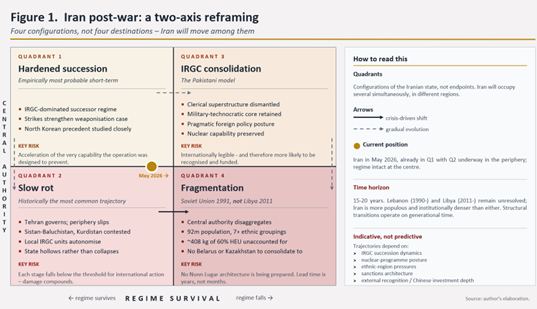
Source: author’s elaboration
Regime survives, central authority maintained – the “hardened succession” outcome (Q1). Empirically the most probable near-term configuration. Mojtaba Khamenei’s confirmation and survival (as the living vessel of a succession narrative), IRGC operational continuity, and the absence of mass protests during the bombing, all suggest institutional resilience. The configuration is not stable. A successor that has lost its founding leader, watched its conventional military take catastrophic losses, and absorbed the operational lesson that nuclear ambiguity invited an attack rather than deterred it, will rebuild on a different basis. The assessment is that the strikes may have strengthened the political case for weaponisation within Iran – and, arguably, elsewhere as well – capturing the irony of the outcome[14]. The regime survives – and accelerates the very capability the operation was designed to prevent. The North Korean precedent has been studied closely in Tehran.
Regime survives, central authority degrades – the “slow rot” outcome (Q2). Historically the most common trajectory. Tehran continues to govern formally and maintain coercive authority in the major cities, but its capacity to project authority into Sistan-Baluchistan, the Kurdish provinces, Khuzestan, and the eastern frontier with Afghanistan progressively erodes. Local IRGC and Basij units, no longer reliably paid, begin to operate as autonomous regional networks rather than instruments of central command. The state does not collapse; it hollows. Each stage of degradation falls below the threshold for international action, and the cumulative damage is largest precisely for that reason.
Regime falls, central authority maintained – the “IRGC consolidation” outcome (Q3). A constitutional regime change in which the clerical superstructure is dismantled but the IRGC remains as the operational core. The model is approximately Pakistani: a military-technocratic authority retaining nuclear capability, conducting foreign policy with greater pragmatism, dropping the most ideologically maximalist commitments. Rhetorically less alarming than its alternatives, but operationally more dangerous in one respect: a post-clerical IRGC state is more legible to international diplomacy, more capable of negotiating credible commitments, and consequently more likely to receive the recognition and reconstruction support that consolidates its (nuclear) position. Europe should be careful what it wishes for.
Regime falls, central authority breaks down – the “fragmentation” outcome (Q4). The configuration most often invoked, most often misunderstood, and most often modelled on the wrong analogy. Libya is the wrong frame: Libya’s pre-war population was approximately 6.4 million (2010), predominantly Arab-Berber in composition; Iran’s is approximately 92 million across at least seven significant ethnic groupings[15]. Libya’s institutional legacy was the absence of any genuine state structure[16]; Iran’s institutional skeleton – civil service, judiciary, central bank, tax administration – is qualitatively more sophisticated and more durable. The right comparison is the Soviet Union of 1991: a multi-ethnic, multi-confessional, nuclear-armed state whose central authority disaggregated into successor entities of varying legitimacy. That comparison opens onto a question no one is asking – whether a Nunn-Lugar-style cooperative threat reduction architecture[17] is being prepared for the fissile-material control problem a fragmenting Iran would generate[18]. The honest answer is that it is not. Iran possesses approximately 408 kilograms of 60% enriched uranium of which the IAEA has lost continuity of knowledge[19], sufficient for several weapons within weeks of further enrichment. There is no Belarus, no Kazakhstan, no Ukraine to consolidate the material to. There is no Russia to receive it.
A nuclear breakout in the centre, slow rot in the east, IRGC consolidation in the security apparatus, and pockets of fragmentation in Sistan-Baluchistan are not mutually exclusive.
A nuclear breakout in the centre, slow rot in the east, IRGC consolidation in the security apparatus, and pockets of fragmentation in Sistan-Baluchistan are not mutually exclusive – they are the most plausible composite outcome.
The eastern vacuum: the inversion no one is namingFor the better part of two decades, Iran has functioned as a significant – if self-interested – regional force in suppressing Sunni jihadism directed at Shia communities and Iranian state interests[20]. The Quds Force deployed to Iraq from June 2014 and played a central operational role in the fight against the Islamic State[21]. In Syria, Iran’s sustained military support for the Assad government served multiple objectives: preserving the land corridor to Hezbollah, maintaining a forward position against Israel, and – as a secondary effect – denying ISIS the territorial contiguity its proto-state required[22]. The IRGC has conducted repeated operations against Jaish ul-Adl in Sistan-Baluchistan, a Sunni Baluch militant group designated as a terrorist organisation by both Iran and the US[23].
If that capacity is degraded – by the war, by the succession, by the fiscal pressure of reconstruction, or by all three – the suppression collapses. ISIS-Khorasan Province (ISKP) does not need to conquer Iran. It needs Iran to be unable to police its own eastern frontier. The UN Analytical Support and Sanctions Monitoring Team has assessed ISKP as posing “the greatest extraregional terrorist threat” in its current configuration[24], with documented operational reach into Iran, Russia, and Western Europe[25]. The 3 January 2024 Kerman bombing against a Soleimani commemoration was conducted by ISKP Tajik nationals[26]. The Crocus City Hall attack in Moscow in March 2024 was the same operational network[27]. As of late 2025, ISKP is assessed as a resilient and still operationally potent affiliate, raising concerns about its potential to conduct high‑impact attacks in Asia or Europe in 2026[28].
The destruction of the IRGC’s external operational capacity produces a vacuum that ISKP, Jaish ul-Adl, Tehrik-e-Taliban Pakistan (TTP) and the constellation of Sunni jihadist networks across the Iran-Afghanistan-Pakistan corridor are already organised to occupy. The principal beneficiary of a degraded IRGC is the actor that has spent the past years rebuilding the operational infrastructure that the 2017 territorial defeat of ISIS was meant to have settled definitively.
Europe risks inheriting Iran-backed hybrid operations on European soil and a resurgence of jihadist radicalisation in its own neighbourhood simultaneously.
For European security services, the threat geometry is about to change in two channels at once. MI5 disrupted over forty Iran-backed plots in the UK between January 2022 and October 2025[29]. Successive Europol TE‑SAT reports document a pattern of jihadist plots in Belgium, France, Germany and Austria, with several transnational networks linked to the Islamic State and ISKP[30]. Iran-backed plots may, under fiscal pressure, become marginally less capable; ISKP networks, freed from their principal regional adversary, will become more so. Europe risks inheriting Iran-backed hybrid operations on European soil and a resurgence of jihadist radicalisation in its own neighbourhood simultaneously – the very combination of state‑assisted hybrid attacks and homegrown jihadist activity the 2017 territorial defeat of ISIS was supposed to have put an end to.
Reconstruction: the centerpiece is BeijingThe standard treatment of reconstruction proceeds through familiar coordinates: Washington has no appetite; Brussels has financial capacity but lacks operational presence as evidenced by their absence at the negotiation table; the Gulf states have means and proximity but limited will to help the neighbour that attacked them. Each observation is correct. Each is also peripheral, because the actor that will most consequentially shape the architecture is not present in the conventional Western framing at all.
China imported approximately 1.5 million barrels per day of Iranian (sanctioned) crude through 2025[31], accounting for roughly 90% of Iran’s oil exports and 12% of China’s total crude imports[32]. The 2021 Comprehensive Strategic Partnership agreement with Iran commits China to up to $400 billion in Iranian energy, banking, and infrastructure investment over twenty-five years against a discounted Iranian oil supply[33]. When the strikes began on 28 February, Beijing absorbed the immediate cost and is still continuing to do so. The IMF’s April 2026 World Economic Outlook revised China’s 2026 growth forecast downward 0.1% points from January to 4.4% – a modest revision reflecting Chinese strategic stockpiles, diversified sourcing, and overland Russian supply[34]. The cost is real but absorbable.
Beijing’s broader grand strategy of strategic patience: advancing its long-term interests without triggering immediate retaliation or coercive measures from the US or its allies. […] Beijing accumulates three structural gains.
The strategic return on absorbing it is considerable. China has positioned itself, throughout the war, as the calm power: condemning the strikes, calling for de-escalation, blocking US-led UNSC resolutions, and presenting itself as the multilateral interlocutor. This is not a contradiction with simultaneously enabling Iranian sanctions evasion through the Shandong “teapot” refinery network[35] and the shadow tanker fleet; it is the same strategy operating on two timelines. This dual-track approach allows China to reap the strategic benefits of Iranian oil – lower prices, increased leverage over global energy markets, and enhanced bargaining power in negotiations with both Tehran and Washington – while maintaining plausible deniability and limiting direct diplomatic fallout. It reflects Beijing’s broader grand strategy of strategic patience: advancing its long-term interests without triggering immediate retaliation or coercive measures from the US or its allies. In doing so, Beijing accumulates three structural gains.
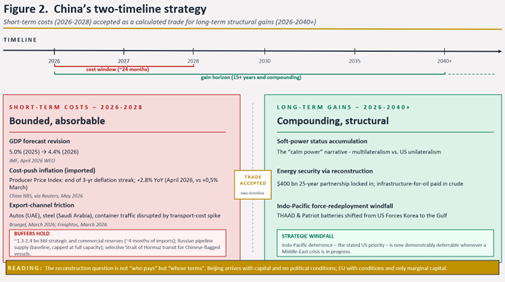
Sources: IMF, “World Economic Outlook: Global Economy in the Shadow of War”, 04/2026, p. 7; Alicia García-Herrero, “What the war in Iran means for China”, Bruegel, Analysis 06/2026, 17/03/2026; Yukun Zhang and Liz Lee, “China’s factory inflation hits 45-month high on energy price shock”, Reuters, 11/05/2026; Freightos, “Iran war pushing air rates up, and disrupting ocean”, Weekly freight updates, 10/03/2026.
First, status. China is establishing itself as the rising superpower whose conduct during a Middle Eastern crisis is characterised by restraint and adherence to international consensus, in deliberate contrast to the US, which undermines the very rules-based order it claims to defend. This will be the main soft-power win from the post-war moment, achieved without deploying a single military asset.
Second, energy security through reconstruction. Whatever post-war configuration emerges in Tehran, China will be present at the reconstruction table – in some respects, China is the reconstruction table. The infrastructure-for-oil arrangements pre-date the war[36]; they will be expanded after it. Chinese state enterprises will build the airports, refineries, and transport networks any post-war Iranian government will require – and will be paid in crude.
Third – the dimension that should most concern European and Indo-Pacific planners – a defence-industrial window. The Iran war has depleted US precision-munitions stocks at a rate without recent precedent: approximately $1.9 billion per day in operational expenditure in the opening phase, $16.5 billion by Day 12, much of it on interceptors expended against Iranian drone and missile salvoes[37]. As of March 2026, the US was actively transferring elements of THAAD and Patriot air defence batteries from US Forces Korea to the Middle East – effectively leaving the Indo-Pacific flank exposed and vulnerable to Chinese coercion, precisely when Washington lacks the long-range munitions, air defense systems, and interceptors needed to deter or fight a protracted war with China[38]. The 2025 National Security Strategy had identified Indo-Pacific deterrence – and specifically the prospect of conflict with China over Taiwan – as the principal organising priority of US force posture[39]. What the Iran war has produced is not a deferral of that priority by political choice, but by material constraint. Replenishing US’ depleted stocks will take years. European defence-industrial timelines are similar. China’s relative position improves not by its own action but by the involuntary slowdown in Western output, and the time gained will allow to close the qualitative gaps that remain in some Chinese platforms.
The Gulf will also play a role, but a different one than is commonly assumed. Saudi Arabia and the UAE have the financial means and the proximity to engage substantively. The UAE’s posture, articulated through the closure of its Tehran embassy, its withdrawal from OPEC+, and accelerated bilateral defence cooperation with Israel, is to harden against post-war Iran[40]; Saudi Arabia, having maintained its Tehran channel and joined the quadrilateral mediation effort with Egypt, Turkey, and Pakistan, is positioning to manage rather than confront[41]. The Gulf reconstruction contribution will be real but politically conditional, sectorally specific, and unlikely to operate through a unified GCC framework given the documented Saudi-UAE divergence on Yemen, Sudan, and now Iran.
Where Europe still has leverage, and where it has already lost itEurope was not at the table at the Islamabad talks of 12 April 2026. The negotiations that collapsed after 21 hours involved the US and Iran, mediated by Pakistan; the six countries whose airports, energy infrastructure and civilian neighbourhoods had been struck during the preceding 40 days were not formally consulted, nor was any European country or EU institution. Nor were they in the subsequent phases. That window has closed. The leverage Europeans hold from this point onward is not the leverage of presence at the negotiating architecture, but the leverage of structural positions they still hold outside it. Three remain: procedural-political (sanctions), technical (verification), and economic (reconstruction inputs). The first two leverages are still exercisable; the third is a residual hold that China is methodically substituting on a deliberate long timeline. All three are structural positions Europeans have, in similar past circumstances, forfeited by default.
The first is the sanctions architecture. The September 2025 snapback of UN sanctions[42], invoked by France, Germany and the United Kingdom (the “E3”) under UNSC Resolution 2231, restored the pre-2015 sanctions regime against Iran[43]. Unlike bilateral US sanctions, the UN architecture cannot be lifted unilaterally by Washington. Any reconstruction trajectory that requires sanctions relief must, at the UN level, pass through the “E3”. At the EU level, the same is true through its autonomous proliferation-related sanctions architecture it reimposed in parallel with the snapback, through Council regulations[44]. This second layer is purely European, modifiable only by the Council, meaning that any comprehensive economic component of an Iran settlement must also pass through European political scrutiny. This is the most concentrated point of European influence in the post-war period and yet the most easily traded away or disregarded – as evidenced in the current negotiations, the Trump administration has proceeded as though the EU/UN sanctions architecture were a mere administrative formality, a footnote to be inserted in the final deal. Any decision to support sanctions relief without commensurate political conditionality (verified IAEA re-access, operational dismantling of the IRGC’s external operations apparatus, specific commitments on the proxy network) converts this leverage into a one-time gift. The precedent of Iraq, Afghanistan and Libya, where European reconstruction commitments were extended without strategic conditionality, suggests this is the default trajectory unless a deliberate decision is taken otherwise.
The second is the verification and export control infrastructure. The IAEA has explicitly acknowledged that it has lost continuity of knowledge over Iran’s enriched material[45]. Any post-war re-establishment of inspector access will rest on technical infrastructure in which the EU holds a distinct institutional position. The European Commission’s Joint Research Centre operates the principal non-US supporting infrastructure for IAEA environmental sample analysis in 3 different locations[46]. These are EU institutional assets structurally integrated into the IAEA’s safeguards verification system. The multilateral export-control architecture through which Iranian reintegration into the global nuclear economy must pass – the Nuclear Suppliers Group, Missile Technology Control Regime, Wassenaar Arrangement – operates by consensus[47]: a settlement that bypasses these regimes does not deliver reintegration, and one that goes through them goes necessarily through European votes.
The third position is hybrid: a residual leverage today, but a structural advantage China is methodically working to substitute. The EU and its Member States currently hold, at the technical and regulatory frontier of reconstruction, inputs no other actor can replace in the near term – euro-clearing and the European banking system through which any non-Chinese/Asian component of sanctions relief must operate[48]; the energy-services expertise of TotalEnergies, Eni, and Shell; the EU dual-use export control regime[49]; and a significant share of the estimated $100 billion Iranian frozen funds globally, whose release is a European political decision. None of these is replicable by Beijing in 2026. But each is being progressively eroded along a trajectory China has been deliberately constructing since the 2018 US withdrawal from the JCPOA. In the Iran-China bilateral channel, yuan settlement is now operational and growing through China’s Cross-Border Interbank Payment System (CIPS), though the system remains a fallback rather than a substitute at scale[50]. The European banking system continues to chokepoint Iran’s trade with non-Chinese/Asian partners [51] but no longer chokepoints the Iran-China channel itself. The technical lead of European oil majors – exposed between 2018 and 2019 when CNPC inherited TotalEnergies’ operatorship on South Pars Phase 11 and then withdrew without delivering[52] – is being closed through Chinese involvement in sanctioned Iranian and Russian projects. Chinese-based procurement networks have substantially eroded the enforcement reach of the EU dual-use regime since 2018 by serving as transshipment hubs and front-company intermediaries that route US, European, and Japanese-origin components to Iranian missile, drone, and other military programmes; the European regulatory architecture still nominally governs export licensing but is increasingly defeated at the implementation layer. Frozen assets remain a uniquely European hold on past Iranian holdings, but future reserves placed in yuan and Chinese banking infrastructure route around this leverage entirely.
China will invest in infrastructure, energy, and logistics, setting the technical standards and accepting zero conditionality on governance.
The implication for European reconstruction planning is therefore not what the conventional Western reading suggests. Europe will pay (substantially, on humanitarian assistance, refugee management, civil society and judicial reconstruction, transitional justice), by “normative-power reflex”, and because these are the categories that translate least into political influence and that Beijing is content to leave to others. China will invest in infrastructure, energy, and logistics, setting the technical standards and accepting zero conditionality on governance. Europeans risk watching the strategic shape of the country they are helping to feed be determined elsewhere. This is the recurring pattern of European Middle East and Sahel policy: in Iraq, European reconstruction commitments since 2003 have produced little political weight in Baghdad; in the Sahel, two decades of European development and security investment did not prevent the active expulsion of EU CSDP missions between 2022 and 2024, and European actors are now perceived primarily through the very colonial register the investments were meant to displace. What distinguishes Iran from these precedents is the time horizon. The European inputs are real today; their Chinese substitution is a project of years for some categories and decades for others. The window in which European reconstruction conditionality could be exercised as leverage, is open. But it is narrow, and it is closing.
…the relevant question is therefore no longer whether the EU has a leader but which capital is best placed to lead.
The emerging architecture. What no structural position can substitute for is the political agency to exercise it. France has begun to construct that agency on three fronts, each whose translation into European leverage is contingent on partners following. The “dissuasion avancée” doctrine presented by President Macron at Île Longue on 2 March 2026 opened a Franco-European nuclear dialogue with eight partners[53] and was framed against a deteriorating strategic environment shaped by Russian coercion, uncertainty over U.S. extended deterrence, and the wider fallout of the Iran conflict[54]. The Strait of Hormuz maritime navigation initiative co-chaired by Macron and Prime Minister Starmer on 17 April 2026 assembled 49 non-belligerent states around an instrument explicitly designed to be more agile than EU consensus permits[55], and notably without US participation[56]. Macron’s Athens visit on 25 April 2026 extended the 2021 Franco-Greek Strategic Partnership Agreement and used the occasion to elevate Article 42.7 TEU – the EU’s mutual assistance clause, used only once by France itself – as the operative legal architecture for European collective defence, described by Macron as “reinforced concrete” (béton armé) and “stronger” than NATO Article 5[57]. The recent joint Franco-Greek response (even without activation of article 42.7 TEU) to the drone attack on the British airbase at Akrotiri (Cyprus) during the US-Israel strikes on Iran was cited as evidentiary proof that the clause operates as a binding commitment rather than a symbolic gesture. The relevant strategic actor in these initiatives is France leading the way with whatever partners can be assembled. Whether Berlin, Rome, Madrid, Warsaw, and other capitals convert these initiatives into a sustained European posture will determine whether the structural leverage outlined above is translated into operational leverage in the coming decade. Either path settles a question European strategic discourse has long preferred to leave ambiguous. In the first, partners step up and the EU institutional framework absorbs what France has begun, giving the architecture the appearance of multilateral/European cohesion. In the second, partners do not step up, and the post-war moment formalises what the recurring pattern of European foreign and security policy (from the “E3” on Iran to the Normandy format on Ukraine, from Operation IRINI in the Mediterranean to the Indo-Pacific strategy) has already been making increasingly difficult to deny: that the EU does not lead in the sense the term is usually understood. European leverage, as exercised, depends on lead states willing to act ahead of consensus, and the relevant question is therefore no longer whether the EU has a leader but which capital is best placed to lead on which file (and the depth of the lead). The two paths are not equally probable; the empirical record of EU CFSP/CSDP overwhelmingly favours the lead-state model.
What is missing is not capacity. It is political will to convert capacity into coordinated action before the reconstruction trajectory institutionalises around configurations that no longer admit European conditionality. The window is approximately the next eighteen months.
Conclusion: the cost of strategic absenceThe war that didn’t start, did not, in any meaningful sense, stop.
The war that didn’t start, did not, in any meaningful sense, stop. The Iranian state continues under economic siege, partial territorial fragmentation in its eastern provinces, accelerating nuclear ambition, an external proxy network in operational uncertainty, and a reconstruction landscape whose principal financier is a power whose strategic interests are not aligned with any European preference. The morning after is not a moment. It is a 15 to 20-year process whose first eighteen months will determine its shape.
The recurring pattern of European Middle East policy – absent at the political architecture, present at the financing, surprised at the outcome – has been remarked upon for the better part of three decades. What the 2026 conflict has done is render the pattern’s costs immediate rather than deferred. Migration flows from a fragmenting Iran will not terminate at the EU’s external border; the proliferation cascade will not respect the Mediterranean; the ISKP operational tempo will not pause for European institutional consensus; the reconstruction investments shaped by Beijing will not be re-shaped by Brussels after the fact.
The choice now facing European institutions is not whether to be involved in post-war Iran. The choice is whether the involvement will be strategic or supplementary.
The choice now facing European institutions is not whether to be involved in post-war Iran. The choice is whether the involvement will be strategic or supplementary. The institutional and political prerequisites for strategic involvement are achievable on the 18-month timeline the war has imposed. They are not, on current evidence, being assembled. The bill for the Iran war will, as the previous paper in this series argued, come due over years rather than weeks. The bill for European strategic absence will come due faster.
Policy recommendations
- European institutions must condition all reconstruction financing on verifiable political outcomes – IAEA re-access to Iranian nuclear material, dismantling of the IRGC’s external operations apparatus, and substantive commitments on proxy networks. Conditionality requires institutional unity across the “E3” and substantive coordination with the EU institutions; it cannot be assembled bilaterally after the fact.
- The E3 should treat the snapback sanctions architecture as a strategic asset rather than a bargaining chip. Any sanctions relief negotiated through the post-war process must be sequenced against verified political and proliferation outcomes, not bundled into a single grand bargain.
- European defence, intelligence and counter-terrorism services should prepare urgently for the inversion of the regional Sunni-jihadist threat geometry. The degradation of IRGC counter-jihadist capacity, combined with ISKP’s documented operational reach, will produce simultaneous changes in both Iran-backed hybrid operations on European soil and Sunni jihadist threat profiles. The institutional reflex to treat the two threats as separate categories must be replaced by an integrated framework.
- The EU and its member states must build a Nunn-Lugar-equivalent fissile material control architecture for the contingency of Iranian central authority degradation. Approximately 408 kilograms of 60% enriched uranium, of which the IAEA has lost continuity of knowledge, is unaccounted for in any current planning framework. The institutional and technical lead time for cooperative threat reduction architectures is measured in years, not months. It must begin now.
- Europe must convert the French initiatives – forward deterrence, the Strait of Hormuz initiative, the TEU’s 42.7 article – into a sustained European posture. The relevant lead actor is not the EU as an institution but Europe broadly conceived, led by capitals capable of action and capable of federating other countries. Aggregating European money with Chinese capital on equivalent political terms is the worst of available options; the alternative is to act through the channels Europe controls, on the conditions Europe sets.
[1] Operation Epic Fury was declared concluded on 5 May 2026 in a brief statement by US Secretary of State Marco Rubio. See US Department of State, “Statement by Secretary of State Marco Rubio on the conclusion of Operation Epic Fury”, 5 May 2026.
[2] War Powers Resolution of 1973 (Public Law 93-148), Section 5(b): the President must terminate the introduction of US armed forces into hostilities within sixty calendar days unless Congress has declared war or extended the period by law. See also Congressional Research Service, “The War Powers Resolution: Concepts and Practice”, Report R42699, 03/08/2019.
[3] The White House, “National Security Strategy of the United States of America 2025”, Washington, DC: Executive Office of the President, 04/12/2025.
[4] US Department of War, “2026 National Defense Strategy”, 23/01/2026.
[5] Stephen Pomper, “One man’s war”, Foreign Affairs, 03/03/2026; for the documented MAGA split, see Molly Ball, “Can Trump bomb Iran and still be ‘America First’?”, Wall Street Journal/ABC News Daily, 26/06/2025.
[6] Dahlia Scheindlin, “Kill or Die: How Israel’s Netanyahu Has Waged War on Diplomacy for Decades”, Haaretz, 20/03/2026.
[7] Stefanie Hausheer Ali, “’They have been exposed’: The Iran war upends Gulf states’ security and business model”, Atlantic Council, 20/04/2026.
[8] Scott Koch, “The Road to Covert Action in Iran, 1953”, Studies in Intelligence, Vol. 48, No. 2, pp. 33-44.
[9] CIA History Staff Analysis Gerald Haines, “CIA and Guatemala Assassination Proposals 1952-1954”, CIA Historical Review Program, Released as sanitised, 1997.
[10] Directorate of Intelligence, “Chile: Pinochet and the Military [redacted]”, CIA, Declassified and approved for release 07/2000. See also Select Committee to study governmental operations with respect to intelligence activities, “Staff Report: Covert Action in Chile 1963-1973”, United States Senate, 1975.
[11] There is no single canonical “playbook” document. The pattern is reconstructed from operational records. See notably CRS, “Covert Action and Clandestine Activities of the Intelligence Community: Selected Definitions”, Report R45175, 29/11/2022.
[12] Eldar Mamedov, “The Pahlavi Mirage”, Foreign Policy in Focus, 19/02/2026
[13] For the Mojahedin-e-Khalq or MEK’s lack of domestic legitimacy, see CRS, “The Mojahedin-e-Khalq (MEK) or People’s Mojahedin Organization of Iran (PMOI)”, Report R48433, 25/02/2025.
[14] See previous policy paper “The strategy Iran built for forty years – and the war the West still doesn’t understand”, ELIAMEP, Policy paper #204, 05/2026; See also Arms Control Association, “U.S. War with Iran: New and Lingering Nuclear Risks”, Issue Briefs, Vol. 18, Issue 4, 10/03/2026; See Georgia Cole, “The Iran War Risks Triggering a New Wave of Nuclear Proliferation”, Chatham House, 30/03/2026.
[15] See Minority Rights Group, “Iran” country profile, 2024. Persian-share estimates range from 61 to 65%; the variance reflects the absence of authoritative ethnic census data since 1979.
[16] For a deeper dive into Libya’s structure, an excellent read: Peter Cole and Brian McQuinn (eds.), “The Libyan Revolution and Its Aftermath”, Hurst, 02/2015.
[17] The Nunn-Lugar Cooperative Threat Reduction (CTR) programme, established by the U.S. Congress in 1991 (sponsored by Senators Sam Nunn and Richard Lugar), provided funding and technical expertise to secure, consolidate, and dismantle nuclear, chemical, and biological weapons inherited by successor states following the Soviet collapse. It oversaw the denuclearisation of Belarus, Kazakhstan, and Ukraine, and the securing of fissile material across Russia. No comparable multilateral architecture currently exists for a potential Iranian fragmentation scenario. See Center for Arms Control and Non-proliferation, “Factsheet: The Nunn-Lugar Cooperative Threat Reduction Program”, 29/03/2022.
[18] The Soviet collapse left ~30,000 nuclear weapons across four successor states; the architecture took over a decade to consolidate. For more information, see Jason Ellis and Todd Perry (eds.), “Nunn-Lugar’s Unfinished Agenda”, Arms Control Today, 10/1997, republished by the Belfer Center for Science and International Affairs, Harvard Kennedy School.
[19] IAEA, “Verification and Monitoring in the Islamic Republic of Iran in light of UN Security Council resolution 2231 (2015)”, 31/05/2025, pp. 3 and 9; see also “IAEA Director General Grossi’s Statement to UNSC on Situation in Iran”, Vienna, 20/06/2025.
[20] Of note: this counter-jihadist posture, however, coexists with a deliberate and well-documented exception: Iran has consistently financed and armed Hamas and Palestinian Islamic Jihad – both Sunni organisations – on the basis of shared anti-Israel strategic objectives, irrespective of the Sunni-Shia theological divide (Erik Skare, “Iran, Hamas, and Islamic Jihad: A Marriage of Convenience”, European Council on Foreign Relations, 18/12/2023). The IRGC’s regional role is thus best characterised not as a principled counter-jihadist architecture, but as a selectively applied instrument of Iranian geopolitical interest.
[21] With Major General Qasem Soleimani personally coordinating the Iranian-backed Popular Mobilisation Forces. For a deeper dive on the implications of the rise of ISIS in Iran’s immediate neighbourhood for Tehran’s policies in Syria and Iraq, see Dina Esfandiary and Ariane Tabatabai, “Iran’s ISIS Policy”, International Affairs, Vol. 91, Issue 1, 01/2015.
[22] See the CTC Sentinel, “Special Issue”, Vol. 6, Issue 8, 08/2013 and in particular the following article: Karim Sadjadpour, “Iran’s Unwavering Support to Assad’s Syria”, pp. 11-13.
[23] Janatan Sayeh, “Jaish al-Adl Claims Responsibility for Twin Attacks in Iran’s Sistan and Baluchistan”, Long War Journal, 01/10/2024.
[24] UNSC, “Thirty-fifth report of the Analytical Support and Sanctions Monitoring Team submitted pursuant to resolution 2734 (2024) concerning ISIL (Da’esh), Al-Qaida and associated individuals and entities”, S/2025/71, 06/02/2025.
[25] Soufan Center, “Nearing the End of 2025, what is the State of the Islamic State?”, Intelbrief, 19/12/2025.
[26] National Counterterrorism Center, “ISIS-Khorasan (ISIS-K)”, Terrorist Groups, Counter Terrorism Guide, 03/2025. For more information on the development of the terrorist threat in Central Asia, see Brianne Todd, “Assessing the Terror Threat Landscape in South and Central Asia and Examining Opportunities for Cooperation”, statement before the Subcommittee on South and Central Asia, Committee on Foreign Affairs, U.S. House of Representatives, 119th Cong., 26/06/2025.
[27] Jessica Rawnsley, “Nineteen jailed over deadly Moscow concert attack”, BBC, 12/03/2026.
[28] Soufan Center, op. cit.
[29] 20 Iran-backed plots between January 2022 and October 2024 and another 20 between October 2024 and October 2025. Sir Ken McCallum (MI5 Director General), Annual Threat Updates of 8 October 2024 and 16 October 2025.
[30] Europol, “European Union Terrorism Situation and Trend Report (TE-SAT)”, 2024 (pp. 11-14) and 2025 (pp. 23-24) editions.
[31] China imported a record-high 11.6 million barrels per day of crude oil in 2025, including sanctioned crude from Iran and Venezuela. Low oil prices, geopolitical risks, and global oversupply made it strategically advantageous to stockpile Iranian crude as part of China’s energy security strategy, given its heavy reliance on imported oil (over 70% of consumption, 90% seaborne). See Erica Downs, “Where China Gets Its Oil: Crude Imports in 2025 Reveal Stockpiling and Changing Fortunes of Certain Suppliers, Including Those Sanctioned”, Center on Global Energy Policy, Columbia University, SIPA, 29/01/2026. According to China’s General Administration of Customs (GAC), no oil imports have been made from Iran since 2022 – it is generally rebranded as Malaysian. See also Erica Downs, “Implications of the Conflict in the Middle East for China’s Energy Security”, Center on Global Energy Policy, Columbia University, SIPA, 04/03/2026.
[32] US-China Economic and Security Review Commission, “China-Iran Fact Sheet”, 16/03/2026, pp. 4-5.
[33] Ibid., p. 4. See also Austin Ramzy, “Why China Is Doing So Little to Help a Friend under Fire”, Wall Street Journal, 03/03/2026.
[34] International Monetary Fund, “World Economic Outlook”, 04/2026, p. 11.
[35] The term “teapot refineries” refers to independent, smaller-scale Chinese refineries that were historically regional and processed mostly domestic crude oil. In the 2010s, the Chinese government granted them the right to import crude oil, which transformed them into key players in China’s refining sector. Today, teapot refineries play a crucial role in importing sanctioned oil from Iran, Venezuela, and Russia, leveraging their operational flexibility and connections to sanctions-evasion networks while avoiding the stricter geopolitical constraints faced by China’s major state-owned oil companies (such as Sinopec or CNPC – China National Petroleum Company). They rely on sophisticated sanctions-evasion networks involving shadow tankers, ship-to-ship transfers at sea, falsified shipping documentation, and complex financial transactions to obscure the origin of the crude.
[36] The Comprehensive Strategic Partnership agreement signed in Tehran on 27/03/2021.
[37] Mark Cancian and Chris Park, “Iran War Cost Estimate Update”, Center for Strategic and International Studies, 13/03/2026.
[38] Seth G. Jones, “Is the United States prepared for a war with China?”, Center for Strategic Studies, CSIS Brief, 05/2026.
[39] The White House, National Security Strategy of the United States of America 2025, Washington, DC: Executive Office of the President, 04/12/2025, pp. 20 and 23. See also Congressional Research Service (written by Daniel J. Longo), “U.S.-South Korea Alliance: Background and issues for Congress”, Report R48877, 05/03/2026, pp. 14-17.
[40] Javad Heiran-Nia and Hessam Habibi Doroh, “Iran Applies Different Postwar Approaches to the Persian Gulf Arab States”, Stimson Center, 07/05/2026.
[41] Eric Alter, “What Gulf states need in a US-Iran deal”, Atlantic Council, 07/05/2026.
[42] United Nations Security Council, “Resolution 2231”, S/RES/2231, 20/07/2015.
[43] Congressional Research Service (written by Paul Kerr), “Iran”s Nuclear Program and UN Sanctions Reimposition”, Report IF11583, 06/04/2026.
[44] Council Regulation (EU) 2025/1975 of 29 September 2025 amending Regulation (EU) No 267/2012, sectoral measures; Council Implementing Regulation (EU) 2025/1980 of 29 September 2025, reinstating EU autonomous asset-freeze designations; Council Implementing Regulation (EU) 2025/1982 of 29 September 2025, reinstating UN-mandated designations in Annex VIII. All three amend the consolidated framework of Council Council Regulation (EU) 267/2012 of 23 March 2012 concerning restrictive measures against Iran. For a complete overview and timeline, see Council of the European Union, “Iran sanctions snapback: Council reimposes restrictive measures”, press release, 29/09/2025 and Council of the European Union, “Timeline – EU Sanctions against Iran”.
[45] IAEA, “Verification and Monitoring […]”, p. 3, op. cit.
[46] JRC-Karlsruhe (Germany) is an accredited NWAL (IAEA’s Network of Analytical Laboratories (NWAL) for particle analysis) laboratory for particle analysis, see European Commission, “Environmental sample analysis”, Joint Research Center (JRC); JRC-Geel (Belgium) supplies the certified reference materials and interlaboratory comparison programme against which NWAL measurements are calibrated, see IAEA, “The IAEA Safeguards Analytical Laboratories”, Information series, 12-4278/Factsheets/October 2012/E; the EURATOM on-site laboratory at La Hague (France) provides direct measurement capability inside a reprocessing facility, see European Commission, “Operating the Euratom on-site Laboratory”, JRC.
[47] On the consensus rule and membership: Nuclear Suppliers Group, “NSG at a Glance”, Arms Control Association (48 participating governments; all decisions by consensus); Missile Technology Control Regime, “Frequently Asked Questions” (35 partners; informal arrangement; consensus decisions); and Wassenaar Arrangement, “About us” (42 participating states; all Plenary decisions by consensus). On the binding character of European votes in past supply-architecture decisions, see the 2008 NSG waiver for India, in which consensus (admittedly, under US pressure) had to be actively secured from several European holdouts; for analysis, see Mark Hibbs, “Will India and Pakistan Ever Join the Nuclear Suppliers Group?”, Arms Control Today, 11/2024.
[48] The euro is the dominant non-dollar settlement currency, and euro-clearing runs through eurozone infrastructure (notably TARGET2, operated by the Eurosystem) under European regulatory supervision. The INSTEX experience (2019-2023) demonstrated that formal sanctions relief produces no economic effect if European banks decline to process transactions: sustained European banking cooperation is therefore a separate political decision from sanctions removal. See Jack Percival, “The INSTEX project: why did Europe’s ambitious financial vehicle fail, and what next?”, Foreign Affairs Review.
[49] Regulation (EU) 2021/821, 20/05/2021, establishing a Union regime for the control of exports, brokering, technical assistance, transit, and transfer of dual-use items.
[50] Launched by the People’s Bank of China in 2015, CIPS connected 1,683 financial institutions across the globe by May 2025 (with the majority being indirect participants) and processed an annual transaction volume of approximately 175,49 trillion yuan ($24,45 trillion), a 43% year-over-year increase. Daily transaction volume rose to approximately $134 billion in March 2026 – which is not to be read as proof of Iranian oil payments solely, but rather as a sign of broader growth. The system remains nonetheless, for the moment, a “dollar bypass” rather than a substitute at scale: yuan’s share of global SWIFT payments stood at 3% in February 2026, against 24% for the euro and 48% for the dollar. For more information, see Alisha Chhangani, “Inside Tehran’s toll booth”, Atlantic Council, 02/04/2026; see also Joe Baker, “Is China’s cross-border payments network on the rise?”, FXC Intelligence, 04/07/2025.
[51] The EU and its Member states, UK, Japan, South Korea, India, Türkiye, the Gulf states.
[52] In July 2017, Total SA (renamed TotalEnergies in 2021) signed a $4.8 billion contract with NIOC (National Iranian Oil Company) and CNPC to develop South Pars Phase 11 (Total 50.1% as operator, CNPC 30%, Petropars 19.9% as subsidiary of NIOC). Total withdrew in August 2018 following the US reimposition of secondary sanctions; NIOC reassigned the operatorship to CNPC in November 2018, but CNPC withdrew on 6 October 2019 without delivering meaningful development. Petropars became sole developer. The episode is the clearest documented test case of Chinese substitution for a European international oil major in Iranian energy development; the substitution was attempted and abandoned, primarily reflecting Chinese reluctance to defy US secondary sanctions.
[53] The United Kingdom, Germany, Poland, the Netherlands, Belgium, Greece, Sweden, and Denmark.
[54] Élysée, “Discours du Président de la République sur la dissuasion nucléaire de la France”, Île Longue, 02/03/2026; see also Héloïse Fayet, “France has a new nuclear doctrine of ‘forward deterrence’ for Europe. What does it mean?”, Bulletin of the Atomic Scientists, 05/03/2026.
[55] Hereby recognising that the unanimity requirement of EU foreign and security policy is incompatible with the operational tempo of the post-war moment.
[56] Élysée, “Strait of Hormuz maritime navigation initiative”, 17/04/2026; “France-UK joint statement on the Strait of Hormuz”, 17/04/2026.
[57] Élysée and Hellenic Republic Prime Minister’s Office, joint communiqué, Athens, 25 April 2026; on Macron’s elevation of Article 42.7 TEU, see “Mitsotakis-Macron reinforce mutual defense pact as ‘reinforced concrete’ commitment”, Athens Times, 26/04/2026. On the legal architecture itself, see EEAS, “Article 42(7) TEU – The EU’s mutual assistance clause”, 06/10/2022. Of note is also the 2021 Franco-Greek Strategic Partnership on Defence and Security Cooperation which was, at the time of signature, the first bilateral mutual defence pact between two NATO members; Article 2 commits the parties to mutual military assistance “by the use of armed force” in the event of armed aggression, pursuant to Article 51 of the UN Charter – a commitment legally separate from and additional to both NATO Article 5 and Article 42.7 TEU. For a deeper dive, see Bruno Tertrais, “Reassurance and Deterrence in the Mediterranean: the Franco-Greek Defense Deal”, Institut Montaigne, 17/11/2021.
Categories: Diplomacy & Defense Think Tank News
Zambian bureaucratic practices in Chinese-financed digital projects
Drawing on interviews with Zambian officials, bureaucrats, and both Chinese and Zambian professionals in the digital sector, this policy brief examines how Zambian actors have engaged with Chinese-financed digital projects across two administrations: the Patriotic Front (PF) government under Edgar Lungu (2015–2021) and the United Party for National Development (UPND) government under Hakainde Hichilema (2021–present). It argues that the transition from the PF to the UPND widened bureaucratic room for manoeuvre in managing Chinese digital projects, yet these gains remained limited and sometimes fragile, as they were partly offset by personnel reshuffling and relatively weak institutional continuity.
Categories: Afrique, Diplomacy & Defense Think Tank News
Zambian bureaucratic practices in Chinese-financed digital projects
Drawing on interviews with Zambian officials, bureaucrats, and both Chinese and Zambian professionals in the digital sector, this policy brief examines how Zambian actors have engaged with Chinese-financed digital projects across two administrations: the Patriotic Front (PF) government under Edgar Lungu (2015–2021) and the United Party for National Development (UPND) government under Hakainde Hichilema (2021–present). It argues that the transition from the PF to the UPND widened bureaucratic room for manoeuvre in managing Chinese digital projects, yet these gains remained limited and sometimes fragile, as they were partly offset by personnel reshuffling and relatively weak institutional continuity.
Categories: Diplomacy & Defense Think Tank News, Europäische Union
Zambian bureaucratic practices in Chinese-financed digital projects
Drawing on interviews with Zambian officials, bureaucrats, and both Chinese and Zambian professionals in the digital sector, this policy brief examines how Zambian actors have engaged with Chinese-financed digital projects across two administrations: the Patriotic Front (PF) government under Edgar Lungu (2015–2021) and the United Party for National Development (UPND) government under Hakainde Hichilema (2021–present). It argues that the transition from the PF to the UPND widened bureaucratic room for manoeuvre in managing Chinese digital projects, yet these gains remained limited and sometimes fragile, as they were partly offset by personnel reshuffling and relatively weak institutional continuity.
The oil shock and the new political economy of development cooperation
The 2026 US–Israel–Iran war and the closure of the Strait of Hormuz have triggered one of the largest oil supply disruptions in modern history. Brent crude prices rose sharply, producing a major external shock for oil-importing developing economies at a moment when the international development system was already under severe strain. Petrochemical products shipped through the strait are also vital for agriculture, medicine and industry. The largest contraction on record of official development assistance (ODA) had already been recorded in 2025, while geopolitical tensions and rising defence expenditures are reshaping ODA spending priorities and development policy directions.
This brief examines how the oil shock will impact development cooperation. The significance of the oil shock lies not only in the price increase itself but also in its timing, and it arrives amid an ongoing reconfiguration of development cooperation. The analysis is organised around two postulates that underpin the post–Cold War development architecture. The first is the existence of states in the Global South with sufficient authority and developmental aspirations and capacity to pursue broad-based development goals. The second is the existence of donor countries willing and able to support those states’ aspirations.
The oil shock weakens both postulates through different mechanisms. For many oil-importing developing countries, rising fuel, food and transport costs intensify fiscal stress, debt vulnerabilities and pressures on state capacity. Fragile states without strategic importance are especially exposed. At the same time, donor countries face mounting pressures
from fiscal tightening, defence spending, domestic cost-of-living politics and growing scepticism towards multilateralism. These dynamics risk reinforcing one another in the sense that weakening state capacity can intensify instability, while rising instability may further reduce political support for development co-operation in donor countries.
The brief argues that alternative financing sources such as Gulf finance, South–South cooperation and climate finance are unlikely to compensate for the scale of OECD donors’ retrenchment. The likely result is a more fragmented, transactional and geographically selective development cooperation system, in which the countries most in need are increasingly among the least likely to receive sustained support unless they hold geopolitical importance.
Three policy implications follow from the war. First, the multilateral development financing architecture requires urgent bolstering. Instruments such as the World Bank’s International Development Association and the IMF’s Poverty Reduction and Growth Trust face growing pressure precisely as low-income countries (LICs) confront simultaneous food, fuel, debt and financing shocks. Second, the increasing concentration of concessional finance to strategically prioritised states should not be treated as inevitable. Fragile states risk declining concessional finance and multilateral reach despite acute humanitarian need. Third, European donors must decide whether development cooperation remains anchored in poverty reduction or becomes subordinated to defence, migration and geopolitical priorities.
Professor Andy Sumner is a professor of International Development at King’s College London and President of the European Association of Development Research and Training Institutes.
Categories: Afrique, Diplomacy & Defense Think Tank News
The oil shock and the new political economy of development cooperation
The 2026 US–Israel–Iran war and the closure of the Strait of Hormuz have triggered one of the largest oil supply disruptions in modern history. Brent crude prices rose sharply, producing a major external shock for oil-importing developing economies at a moment when the international development system was already under severe strain. Petrochemical products shipped through the strait are also vital for agriculture, medicine and industry. The largest contraction on record of official development assistance (ODA) had already been recorded in 2025, while geopolitical tensions and rising defence expenditures are reshaping ODA spending priorities and development policy directions.
This brief examines how the oil shock will impact development cooperation. The significance of the oil shock lies not only in the price increase itself but also in its timing, and it arrives amid an ongoing reconfiguration of development cooperation. The analysis is organised around two postulates that underpin the post–Cold War development architecture. The first is the existence of states in the Global South with sufficient authority and developmental aspirations and capacity to pursue broad-based development goals. The second is the existence of donor countries willing and able to support those states’ aspirations.
The oil shock weakens both postulates through different mechanisms. For many oil-importing developing countries, rising fuel, food and transport costs intensify fiscal stress, debt vulnerabilities and pressures on state capacity. Fragile states without strategic importance are especially exposed. At the same time, donor countries face mounting pressures
from fiscal tightening, defence spending, domestic cost-of-living politics and growing scepticism towards multilateralism. These dynamics risk reinforcing one another in the sense that weakening state capacity can intensify instability, while rising instability may further reduce political support for development co-operation in donor countries.
The brief argues that alternative financing sources such as Gulf finance, South–South cooperation and climate finance are unlikely to compensate for the scale of OECD donors’ retrenchment. The likely result is a more fragmented, transactional and geographically selective development cooperation system, in which the countries most in need are increasingly among the least likely to receive sustained support unless they hold geopolitical importance.
Three policy implications follow from the war. First, the multilateral development financing architecture requires urgent bolstering. Instruments such as the World Bank’s International Development Association and the IMF’s Poverty Reduction and Growth Trust face growing pressure precisely as low-income countries (LICs) confront simultaneous food, fuel, debt and financing shocks. Second, the increasing concentration of concessional finance to strategically prioritised states should not be treated as inevitable. Fragile states risk declining concessional finance and multilateral reach despite acute humanitarian need. Third, European donors must decide whether development cooperation remains anchored in poverty reduction or becomes subordinated to defence, migration and geopolitical priorities.
Professor Andy Sumner is a professor of International Development at King’s College London and President of the European Association of Development Research and Training Institutes.
Categories: Diplomacy & Defense Think Tank News, Europäische Union
The oil shock and the new political economy of development cooperation
The 2026 US–Israel–Iran war and the closure of the Strait of Hormuz have triggered one of the largest oil supply disruptions in modern history. Brent crude prices rose sharply, producing a major external shock for oil-importing developing economies at a moment when the international development system was already under severe strain. Petrochemical products shipped through the strait are also vital for agriculture, medicine and industry. The largest contraction on record of official development assistance (ODA) had already been recorded in 2025, while geopolitical tensions and rising defence expenditures are reshaping ODA spending priorities and development policy directions.
This brief examines how the oil shock will impact development cooperation. The significance of the oil shock lies not only in the price increase itself but also in its timing, and it arrives amid an ongoing reconfiguration of development cooperation. The analysis is organised around two postulates that underpin the post–Cold War development architecture. The first is the existence of states in the Global South with sufficient authority and developmental aspirations and capacity to pursue broad-based development goals. The second is the existence of donor countries willing and able to support those states’ aspirations.
The oil shock weakens both postulates through different mechanisms. For many oil-importing developing countries, rising fuel, food and transport costs intensify fiscal stress, debt vulnerabilities and pressures on state capacity. Fragile states without strategic importance are especially exposed. At the same time, donor countries face mounting pressures
from fiscal tightening, defence spending, domestic cost-of-living politics and growing scepticism towards multilateralism. These dynamics risk reinforcing one another in the sense that weakening state capacity can intensify instability, while rising instability may further reduce political support for development co-operation in donor countries.
The brief argues that alternative financing sources such as Gulf finance, South–South cooperation and climate finance are unlikely to compensate for the scale of OECD donors’ retrenchment. The likely result is a more fragmented, transactional and geographically selective development cooperation system, in which the countries most in need are increasingly among the least likely to receive sustained support unless they hold geopolitical importance.
Three policy implications follow from the war. First, the multilateral development financing architecture requires urgent bolstering. Instruments such as the World Bank’s International Development Association and the IMF’s Poverty Reduction and Growth Trust face growing pressure precisely as low-income countries (LICs) confront simultaneous food, fuel, debt and financing shocks. Second, the increasing concentration of concessional finance to strategically prioritised states should not be treated as inevitable. Fragile states risk declining concessional finance and multilateral reach despite acute humanitarian need. Third, European donors must decide whether development cooperation remains anchored in poverty reduction or becomes subordinated to defence, migration and geopolitical priorities.
Professor Andy Sumner is a professor of International Development at King’s College London and President of the European Association of Development Research and Training Institutes.
The oil shock and the new political economy of development cooperation
The 2026 US–Israel–Iran war and the closure of the Strait of Hormuz have triggered one of the largest oil supply disruptions in modern history. Brent crude prices rose sharply, producing a major external shock for oil-importing developing economies at a moment when the international development system was already under severe strain. Petrochemical products shipped through the strait are also vital for agriculture, medicine and industry. The largest contraction on record of official development assistance (ODA) had already been recorded in 2025, while geopolitical tensions and rising defence expenditures are reshaping ODA spending priorities and development policy directions.
This brief examines how the oil shock will impact development cooperation. The significance of the oil shock lies not only in the price increase itself but also in its timing, and it arrives amid an ongoing reconfiguration of development cooperation. The analysis is organised around two postulates that underpin the post–Cold War development architecture. The first is the existence of states in the Global South with sufficient authority and developmental aspirations and capacity to pursue broad-based development goals. The second is the existence of donor countries willing and able to support those states’ aspirations.
The oil shock weakens both postulates through different mechanisms. For many oil-importing developing countries, rising fuel, food and transport costs intensify fiscal stress, debt vulnerabilities and pressures on state capacity. Fragile states without strategic importance are especially exposed. At the same time, donor countries face mounting pressures
from fiscal tightening, defence spending, domestic cost-of-living politics and growing scepticism towards multilateralism. These dynamics risk reinforcing one another in the sense that weakening state capacity can intensify instability, while rising instability may further reduce political support for development co-operation in donor countries.
The brief argues that alternative financing sources such as Gulf finance, South–South cooperation and climate finance are unlikely to compensate for the scale of OECD donors’ retrenchment. The likely result is a more fragmented, transactional and geographically selective development cooperation system, in which the countries most in need are increasingly among the least likely to receive sustained support unless they hold geopolitical importance.
Three policy implications follow from the war. First, the multilateral development financing architecture requires urgent bolstering. Instruments such as the World Bank’s International Development Association and the IMF’s Poverty Reduction and Growth Trust face growing pressure precisely as low-income countries (LICs) confront simultaneous food, fuel, debt and financing shocks. Second, the increasing concentration of concessional finance to strategically prioritised states should not be treated as inevitable. Fragile states risk declining concessional finance and multilateral reach despite acute humanitarian need. Third, European donors must decide whether development cooperation remains anchored in poverty reduction or becomes subordinated to defence, migration and geopolitical priorities.
Professor Andy Sumner is a professor of International Development at King’s College London and President of the European Association of Development Research and Training Institutes.
The oil shock and the new political economy of development cooperation
The 2026 US–Israel–Iran war and the closure of the Strait of Hormuz have triggered one of the largest oil supply disruptions in modern history. Brent crude prices rose sharply, producing a major external shock for oil-importing developing economies at a moment when the international development system was already under severe strain. Petrochemical products shipped through the strait are also vital for agriculture, medicine and industry. The largest contraction on record of official development assistance (ODA) had already been recorded in 2025, while geopolitical tensions and rising defence expenditures are reshaping ODA spending priorities and development policy directions.
This brief examines how the oil shock will impact development cooperation. The significance of the oil shock lies not only in the price increase itself but also in its timing, and it arrives amid an ongoing reconfiguration of development cooperation. The analysis is organised around two postulates that underpin the post–Cold War development architecture. The first is the existence of states in the Global South with sufficient authority and developmental aspirations and capacity to pursue broad-based development goals. The second is the existence of donor countries willing and able to support those states’ aspirations.
The oil shock weakens both postulates through different mechanisms. For many oil-importing developing countries, rising fuel, food and transport costs intensify fiscal stress, debt vulnerabilities and pressures on state capacity. Fragile states without strategic importance are especially exposed. At the same time, donor countries face mounting pressures
from fiscal tightening, defence spending, domestic cost-of-living politics and growing scepticism towards multilateralism. These dynamics risk reinforcing one another in the sense that weakening state capacity can intensify instability, while rising instability may further reduce political support for development co-operation in donor countries.
The brief argues that alternative financing sources such as Gulf finance, South–South cooperation and climate finance are unlikely to compensate for the scale of OECD donors’ retrenchment. The likely result is a more fragmented, transactional and geographically selective development cooperation system, in which the countries most in need are increasingly among the least likely to receive sustained support unless they hold geopolitical importance.
Three policy implications follow from the war. First, the multilateral development financing architecture requires urgent bolstering. Instruments such as the World Bank’s International Development Association and the IMF’s Poverty Reduction and Growth Trust face growing pressure precisely as low-income countries (LICs) confront simultaneous food, fuel, debt and financing shocks. Second, the increasing concentration of concessional finance to strategically prioritised states should not be treated as inevitable. Fragile states risk declining concessional finance and multilateral reach despite acute humanitarian need. Third, European donors must decide whether development cooperation remains anchored in poverty reduction or becomes subordinated to defence, migration and geopolitical priorities.
Professor Andy Sumner is a professor of International Development at King’s College London and President of the European Association of Development Research and Training Institutes.
The oil shock and the new political economy of development cooperation
The 2026 US–Israel–Iran war and the closure of the Strait of Hormuz have triggered one of the largest oil supply disruptions in modern history. Brent crude prices rose sharply, producing a major external shock for oil-importing developing economies at a moment when the international development system was already under severe strain. Petrochemical products shipped through the strait are also vital for agriculture, medicine and industry. The largest contraction on record of official development assistance (ODA) had already been recorded in 2025, while geopolitical tensions and rising defence expenditures are reshaping ODA spending priorities and development policy directions.
This brief examines how the oil shock will impact development cooperation. The significance of the oil shock lies not only in the price increase itself but also in its timing, and it arrives amid an ongoing reconfiguration of development cooperation. The analysis is organised around two postulates that underpin the post–Cold War development architecture. The first is the existence of states in the Global South with sufficient authority and developmental aspirations and capacity to pursue broad-based development goals. The second is the existence of donor countries willing and able to support those states’ aspirations.
The oil shock weakens both postulates through different mechanisms. For many oil-importing developing countries, rising fuel, food and transport costs intensify fiscal stress, debt vulnerabilities and pressures on state capacity. Fragile states without strategic importance are especially exposed. At the same time, donor countries face mounting pressures
from fiscal tightening, defence spending, domestic cost-of-living politics and growing scepticism towards multilateralism. These dynamics risk reinforcing one another in the sense that weakening state capacity can intensify instability, while rising instability may further reduce political support for development co-operation in donor countries.
The brief argues that alternative financing sources such as Gulf finance, South–South cooperation and climate finance are unlikely to compensate for the scale of OECD donors’ retrenchment. The likely result is a more fragmented, transactional and geographically selective development cooperation system, in which the countries most in need are increasingly among the least likely to receive sustained support unless they hold geopolitical importance.
Three policy implications follow from the war. First, the multilateral development financing architecture requires urgent bolstering. Instruments such as the World Bank’s International Development Association and the IMF’s Poverty Reduction and Growth Trust face growing pressure precisely as low-income countries (LICs) confront simultaneous food, fuel, debt and financing shocks. Second, the increasing concentration of concessional finance to strategically prioritised states should not be treated as inevitable. Fragile states risk declining concessional finance and multilateral reach despite acute humanitarian need. Third, European donors must decide whether development cooperation remains anchored in poverty reduction or becomes subordinated to defence, migration and geopolitical priorities.
Professor Andy Sumner is a professor of International Development at King’s College London and President of the European Association of Development Research and Training Institutes.
Pages


© 2012-2018 Europa Varietas Foundation © 2015-2018 Europa Varietas Association
www.europavarietas.org | info(@)europavarietas(dot)org | Switzerland


We are looking for sponsors for the English translation of these books, please contact turkeandras(at)gmail(dot)com